How to Hot-Start SWAN+ADCIRC

Numerical models such as SWAN and ADCIRC can be started in different ways. The typical start is “cold,” i.e. with all computed quantities set to zero, and then the solution is allowed to develop naturally as the various forcings are applied. However, it is also possible to apply a “hot” start, in which the solution from a previous simulation is used as an initial condition. This page describes how to hot-start the tightly-coupled SWAN+ADCIRC.

As a point of discussion, please consider the following schematic of our hindcast validation of Hurricane Katrina:

Run-Schematic

In our hurricane hindcasts, such as the validations of Katrina and Rita described in papers to be published in Monthly Weather Review, the simulations are performed in two stages. First, a spin-up simulation is run for several days before the start of the hurricane winds, so that the tides and rivers can reach a dynamic equilibrium in the resonant basin of the Gulf of Mexico. Then the solution from that spin-up simulation is used as the initial condition for the hurricane hindcast simulation. For example, for Katrina, we employ an 18-day, tides/rivers spin-up simulation that starts on 07 August 2005, and then we run a 7-day, hurricane simulation that starts on 25 August 2005. The solution from the spin-up simulation is used to hot-start the hurricane simulation.

There are two ways in which the coupled SWAN+ADCIRC could be hot-started during this hindcast. First, it is always hot-started at the beginning of its simulation, at 2005/08/25/0000Z. Although SWAN is not run during the tides/rivers spin-up simulation, because its action is forced entirely by the hurricane winds, we do run ADCIRC during that stage. Thus, when the coupled SWAN+ADCIRC model is employed in the second stage, we must hot-start the ADCIRC half of the simulation. SWAN starts from scratch at the beginning of the hurricane simulation.

Second, we may need to hot-start at some time during the SWAN+ADCIRC stage if it ended abruptly, due to machine failure, user interruption, etc. Instead of re-starting that stage at its beginning, we would rather hot-start in the middle. Then both SWAN and ADCIRC would need to be hot-started, using an intermediate solution as an initial condition for the remainder of the simulation.

Thus, there are two distinct methods in which SWAN+ADCIRC might be hot-started. The first method, in which SWAN is cold-started and ADCIRC is hot-started, would occur in the transition between simulations in the Katrina hindcast. The second method would hot-start both SWAN and ADCIRC, such as at some intermediate time during the second stage of the Katrina hindcast. Instructions for both methods are included below.
Continue reading

Tightly Coupled, Unstructured Mesh, Wave and Circulation Models

In between presenting and writing up our work to couple tightly the SWAN and ADCIRC models, I also designed a poster for the hallway outside our lab.

It emphasizes our transition from the loose coupling with structured-mesh wave models to the tight coupling with the unstructured-mesh version of SWAN. The rectangle in the upper right and the triangle in the lower left are meant to “pop” from the sides of the poster, as shown in the picture to the right. By running on the same unstructured mesh, SWAN and ADCIRC can pass information locally, on the same core or across inter-core boundaries, without the need for global communication.
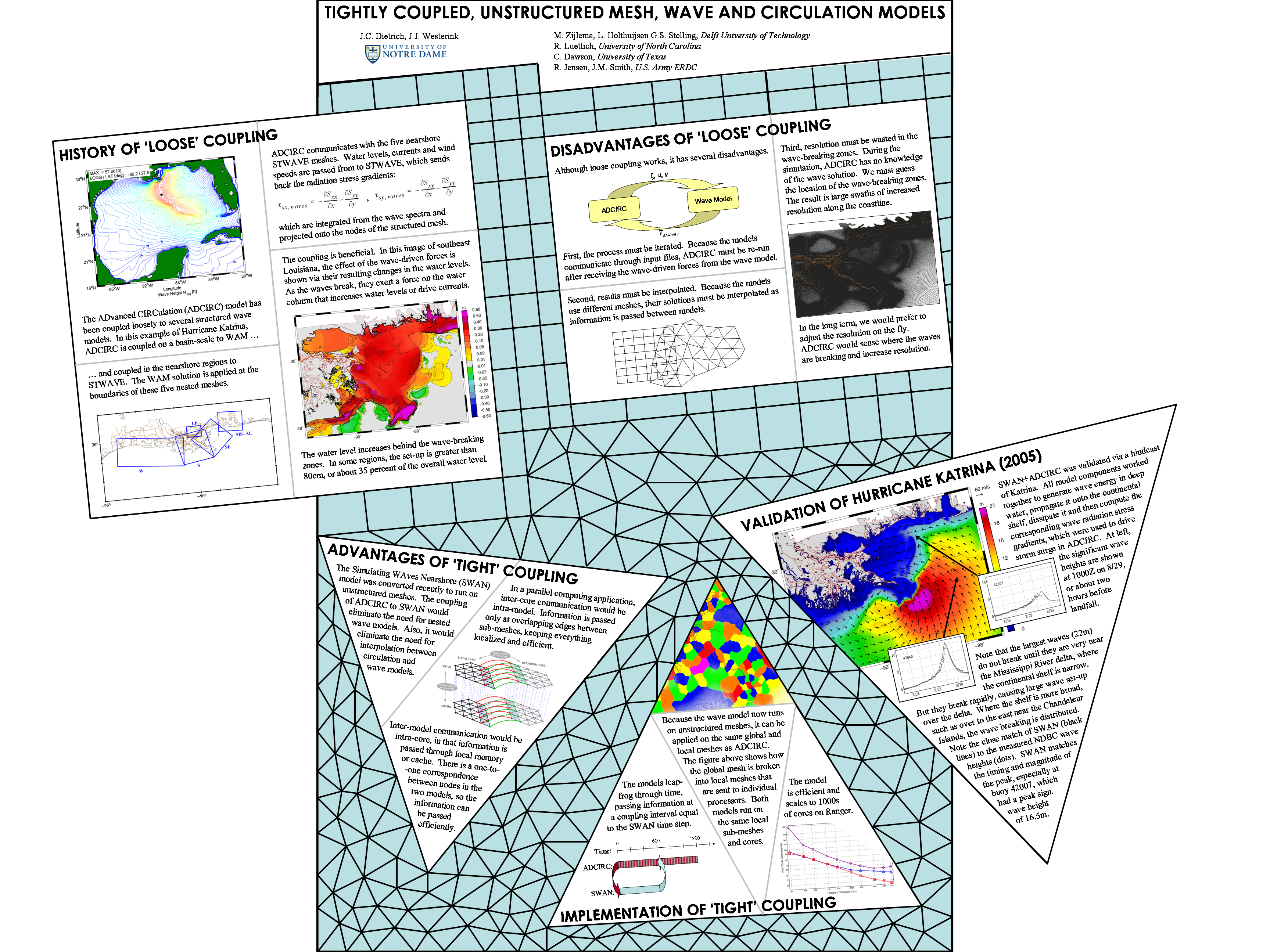
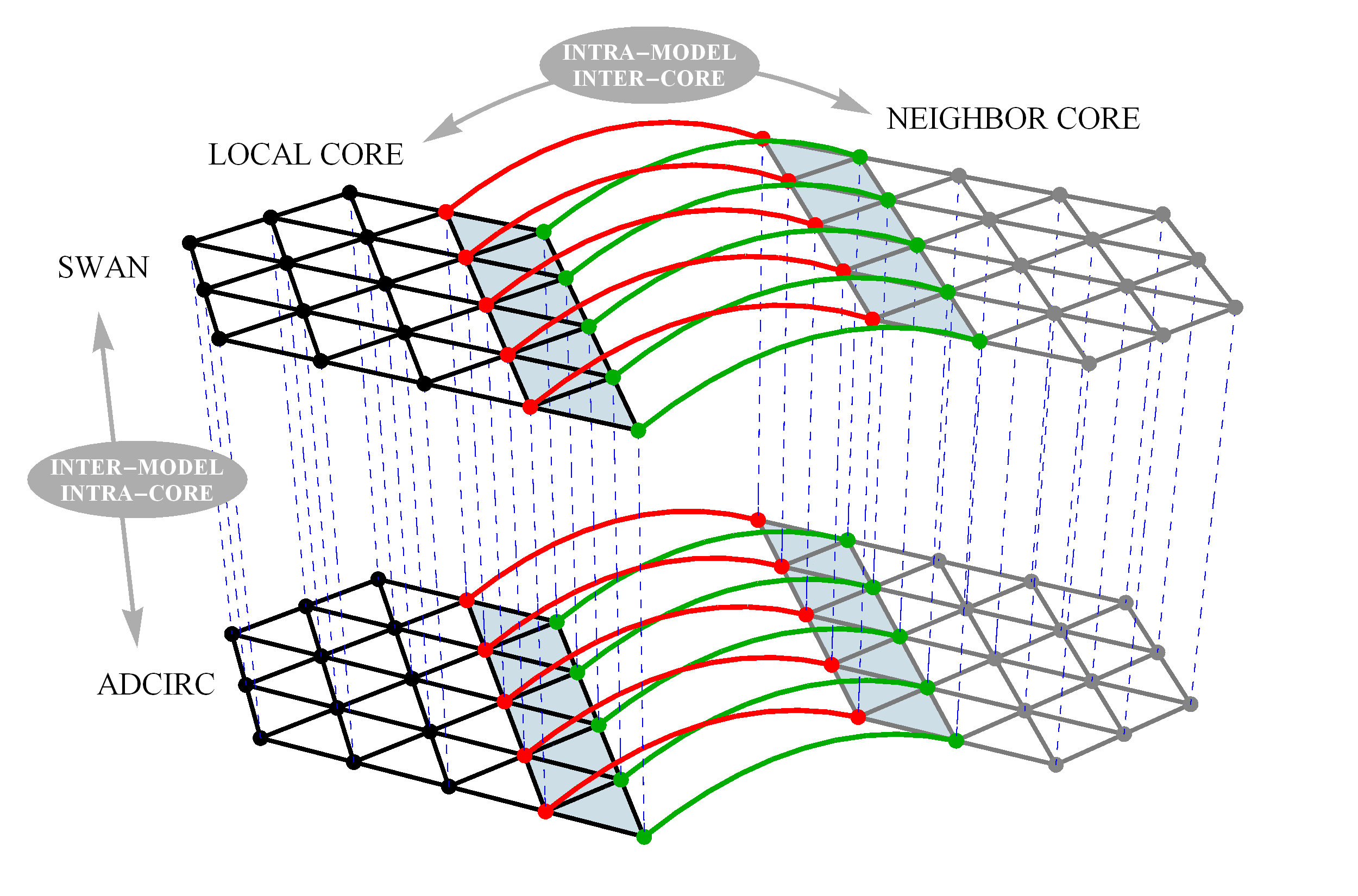
The poster itself is linked below. For more information about the SWAN+ADCIRC model, please visit my Web pages about the coupling. For a copy of our paper describing the coupled model, please contact me, and I would be happy to send it to you.

FigureGen v.41

Updated 2012/06/05: This version of FigureGen has become outdated, but is maintained on this page for reference. Please click here to be redirected to the newest version.

FigureGen is a FORTRAN program that creates images for ADCIRC files. It reads output files (fort.63, fort.64, maxele.63, etc.), grid files (fort.14, etc.), nodal attributes files (fort.13), etc. It plots contours, contour lines, and vectors. Using FigureGen, you can go directly from the ADCIRC input and output files to a presentation-quality figure, for one or multiple time snaps, without having to use SMS.

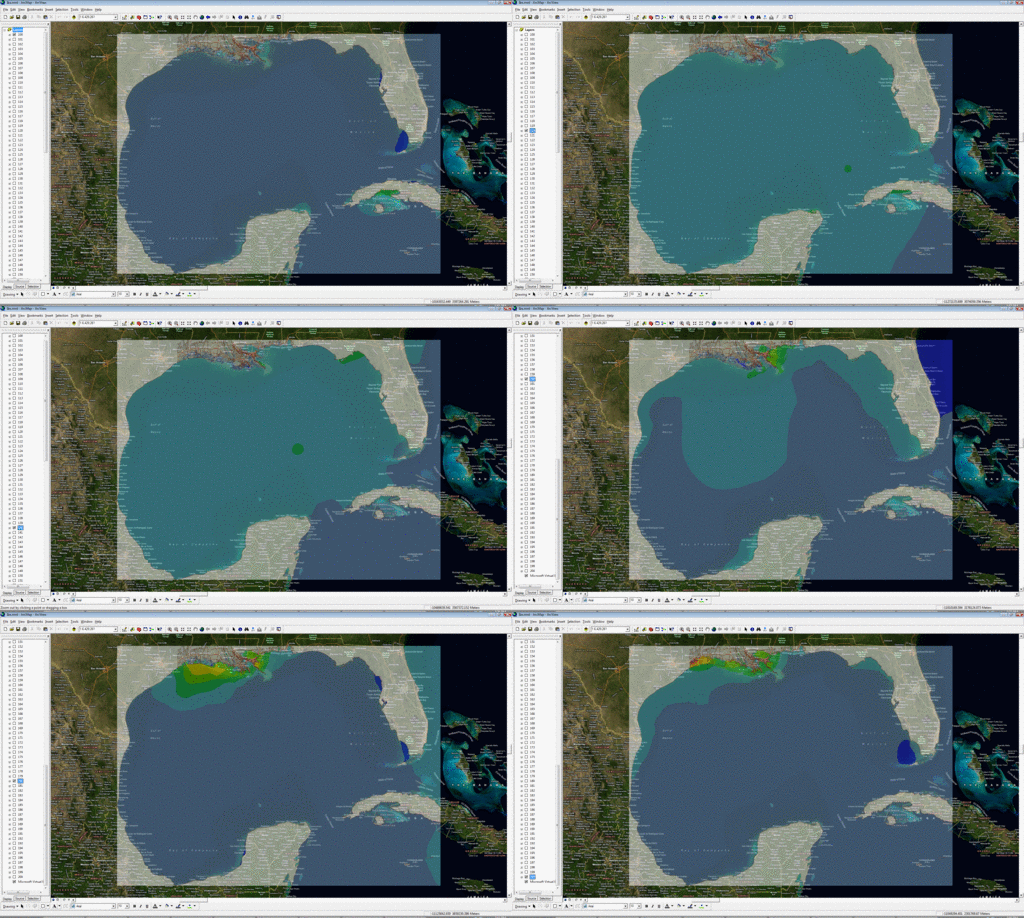
The following example depicts the water levels in ArcGIS as Ike moved through the Gulf:

Contours of water levels (m) in the Gulf of Mexico during Ike (2008), as visualized in ArcGIS.

Contours of water levels (m) in the Gulf of Mexico during Ike (2008), as visualized in ArcGIS.

This program started from a script written by Brian Blanton, and it contains code written by John Atkinson, Howard Lander, Chris Szpilka, Zach Cobell, and others. I converted it to FORTRAN because I am more familiar with that language, and I added the capability to plot vectors, among other things. But, at its core, FigureGen behaves like a script, and it uses system calls to tell other software how to generate the figure(s).

Continue reading

Wave Refraction on Coarse Meshes

Updated 2016/07/31: This post is now outdated. SWAN has been updated to improve its treatment of the spectral propagation velocities, so these limiters are not needed. Please see this post.

Updated 2012/04/12: This is an old page. It persists on this site for posterity, but the information presented below is no longer up-to-date. When you are done here, then please click forward to this page, which describes how to control refraction errors with limiters on the spectral propagation velocities.

Updated 2011/08/30: Added a link to Part 2.

Updated 2010/02/11: Added refraction as a nodal attribute.

At the end of my instruction manual on how to compile and run SWAN+ADCIRC, I noted that wave refraction can cause problems in regions where the resolution of the bathymetry is insufficient. We worked around this problem by turning off the refraction on the local sub-meshes that were not in our region of interest. On this page, I will provide more description of exactly what can go wrong when waves are allowed to refract on coarse meshes, and I will share more details about our work-around.

It should be noted that wave refraction will always be a problem whenever any wave model is applied on a coarse mesh. This is a general numerical problem whenever the user is trying to compute waves turning over more than 90° in one spatial step. This would be a problem with SWAN, WAM, STWAVE or any other wave model, regardless of if/how they are coupled to a circulation model. As we will see, it is the coarse mesh that causes problems with wave refraction.

Continue reading

How to Compile and Run SWAN+ADCIRC

As noted in many of my conference presentations, we have run successfully the coupled SWAN+ADCIRC model on Katrina and Rita on our SL15 mesh without any problems. This is a good sign that everything may be working correctly, but it still needs to be tested. The only way to know if the coupled model is bulletproof is by shooting a bunch of bullets at it.

Coupling-Schematic

If you want the coupled model, then please follow the link at the bottom of the ADCIRC website to request the latest release version. Here is an instruction manual on how to compile and run SWAN+ADCIRC.

Continue reading