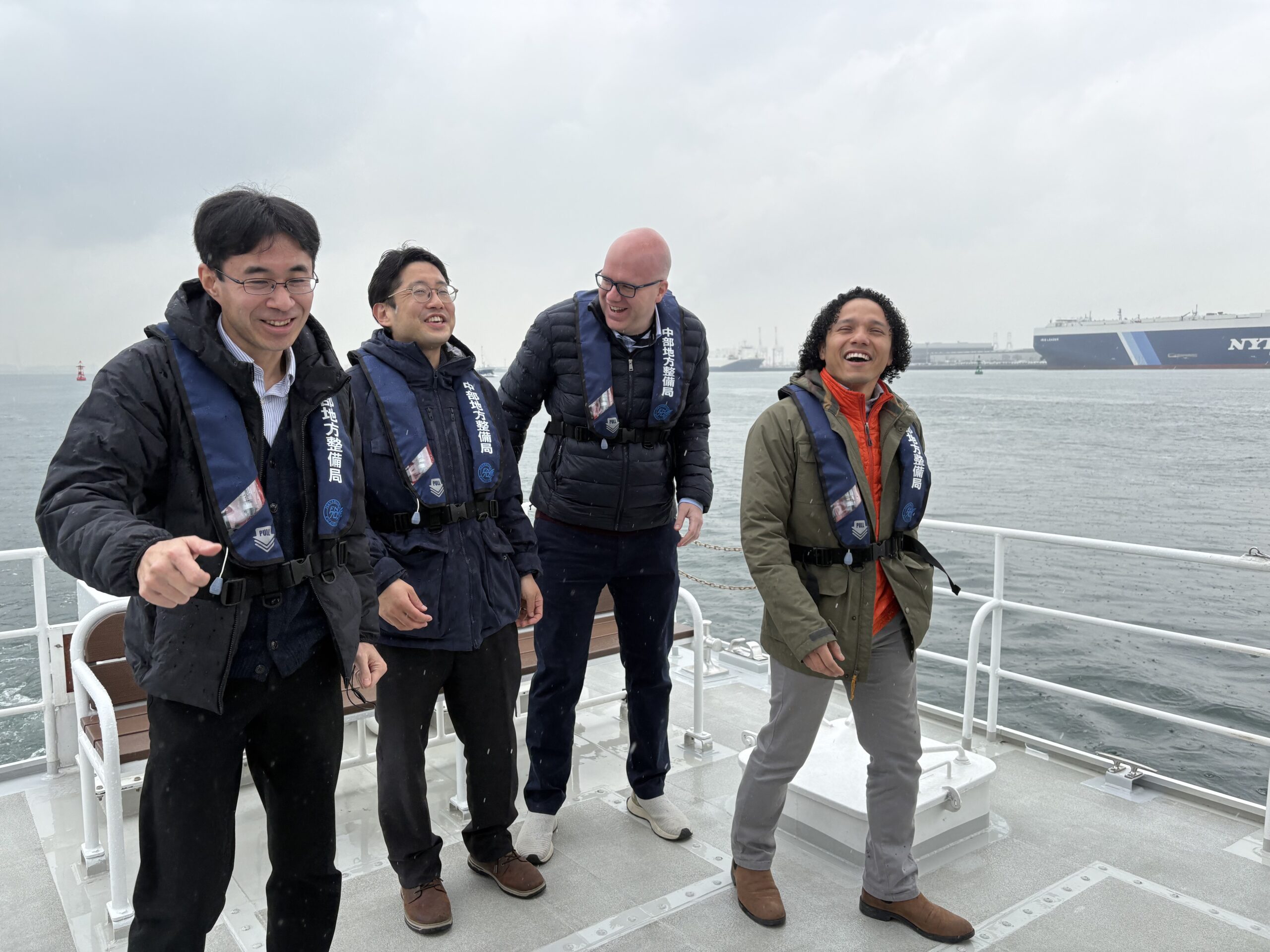
Our project will advance knowledge and technologies to improve resilience for coastal cities. We focus on the resilience of adaptation infrastructure (bridges, storm surge barriers) to changes in climate and shipping. Thus, our project aligns with the seed grant program9s research priority of climate change and sustainability.
Coastal cities are threatened by rising sea levels and stronger storms due to climate change. These hazards have motivated cities to consider adaptations via large infrastructure projects, e.g. bridges, breakwaters in Nagoya, storm surge barriers near Houston and New York City, and the emerald tutu in Boston. However, while numerous studies have predicted the benefits of these adaptations in reducing flooding, much less is known about how they may interact with ships, especially ship crashes. All of these cities are also major ports, and cargo ships continue to grow to and beyond existing infrastructure. Ship crashes have become more noticeable as “more volatile weather caused by climate change and ever-larger container ships mean the risk of losses may be rising.”
As cities (defined broadly to include the cities themselves, but also regional and national governments and agencies, e.g. USACE) consider large adaptations, they often are limited by knowledge gaps related to their technical performance. NC State and Nagoya researchers have the expertise and tools to advance knowledge and improve resilience of coastal adaptation infrastructure, but a seed grant is needed to initiate collaborations across our complementary skillsets.
JC Dietrich, T Nakamura, G Haikal, JE San Juan, Y Cho, T Tomita. “Coastal City Resilience: Infrastructure Adaptation for Ship Impact Mitigation in a Changing Climate.” NC State University, Office of Global Engagement, Nagoya University Collaborative Seed Grants, 2024/07/10, $7,000 and ¥1,000,000 (Dietrich: $2,334).


 An increase in commercial shipping has led to an increase in hazards for ship strikes on bridges, to which we refer as allisions. There is a need for a better understanding of how ships are affected by local flows as they approach an allision. We couple region- and local-scale models to simulate the allision of the container ship Dali with the Key Bridge. Simulations are forced with real tides, river inflows, and atmospheric conditions, and then the ship’s motion is predicted as it drifted and then allided with the bridge’s south pier. The trajectory is a close match to observations, and the allision timing is matched within 70 seconds of the real event. The ship’s southward turn was driven by a cross-channel gradient of 0.22 cm/s in the currents. Perturbations show the trajectory sensitivity to ship and environmental conditions, with many scenarios showing ship motion away from the bridge pier, as much as 500-m down-channel or 200-m to the north side. Simulations with wreckage show the depth-averaged currents may have increased by 10 to 20 cm/s in the temporary alternate channels around the bridge. Our findings can inform models for ship motion and management of navigation channels.