
Tag Archives: Casey Dietrich
Casey wins Outstanding Teacher Award
Casey Dietrich received the NC State Outstanding Teacher Award, which recognizes excellence in teaching at all levels across the university. Faculty members are nominated by their departments, and then finalists are recommended by their colleges. During 2017-2018, the award was given to 17 instructors, or less than 1 per 100 faculty members at NC State.
Recipients of the Outstanding Teacher Award become members of the Academy of Outstanding Teachers for as long as they remain NC State faculty. Recipients are recognized at the Teaching Awards Ceremony in the Spring, and their names are published in the NC State Bulletin and Commencement Program.
This is a great honor, and it reflects Casey’s hard work to implement active, team-based learning in the undergraduate course in fluid mechanics, as well as to establish a set of graduate courses in coastal engineering. He has enjoyed working with students at all levels at NC State.
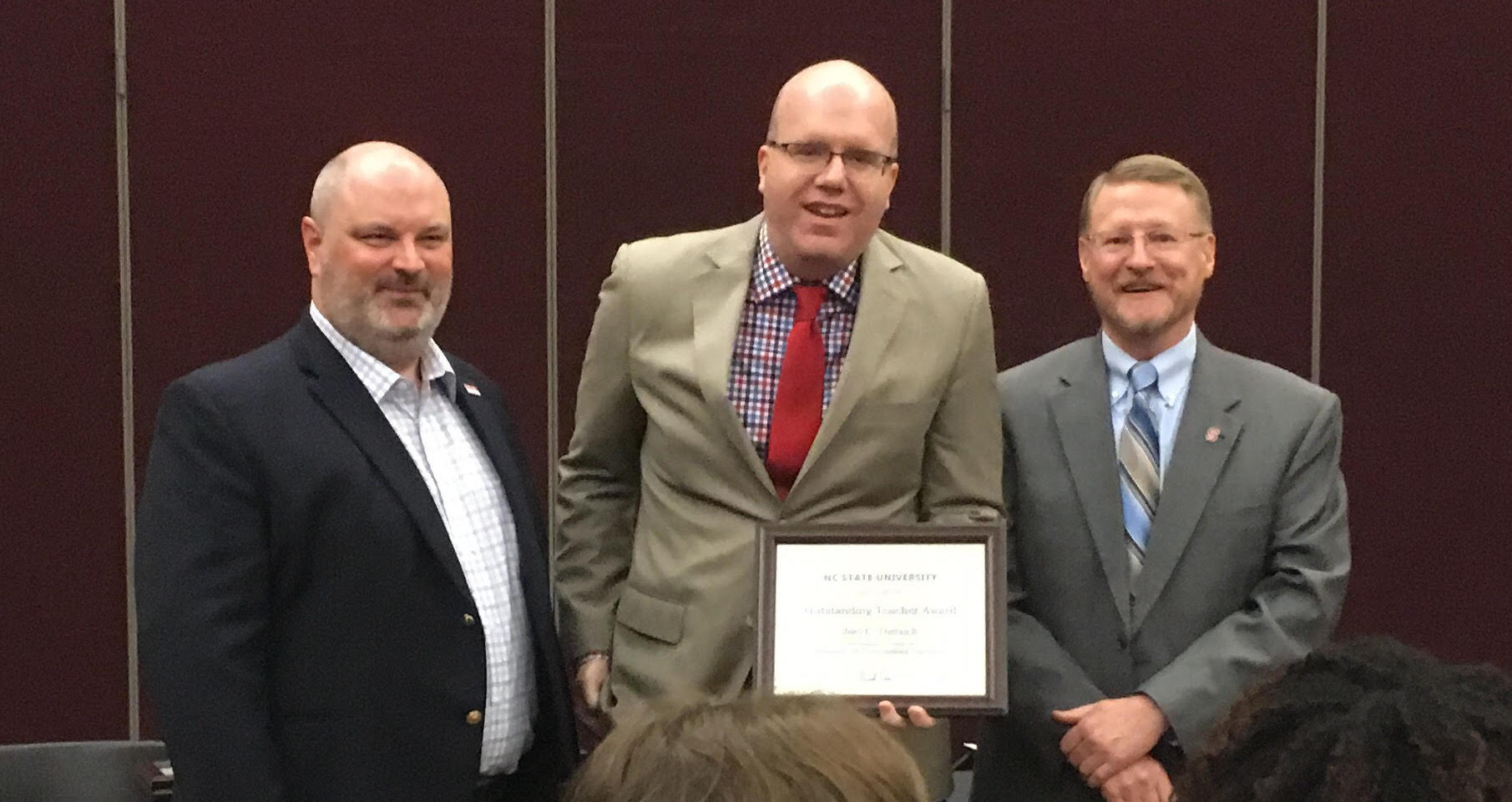
Casey Dietrich accepts the award at the NC State Teaching Awards Ceremony, with (left) Rudi Seracino, Professor and Associate Head for Undergraduate Programs, and (right) Duane Larick, Senior Vice Provost for Academic Strategy and Resource Management.
Poster: Graduate Student Research Symposium 2018
A Thomas, JC Dietrich, JG Fleming, BO Blanton, T Asher, RA Luettich. “High-Resolution Modelling of Surge during Hurricane Matthew (2016).” Graduate Student Research Symposium, North Carolina State University, 21 March 2018.
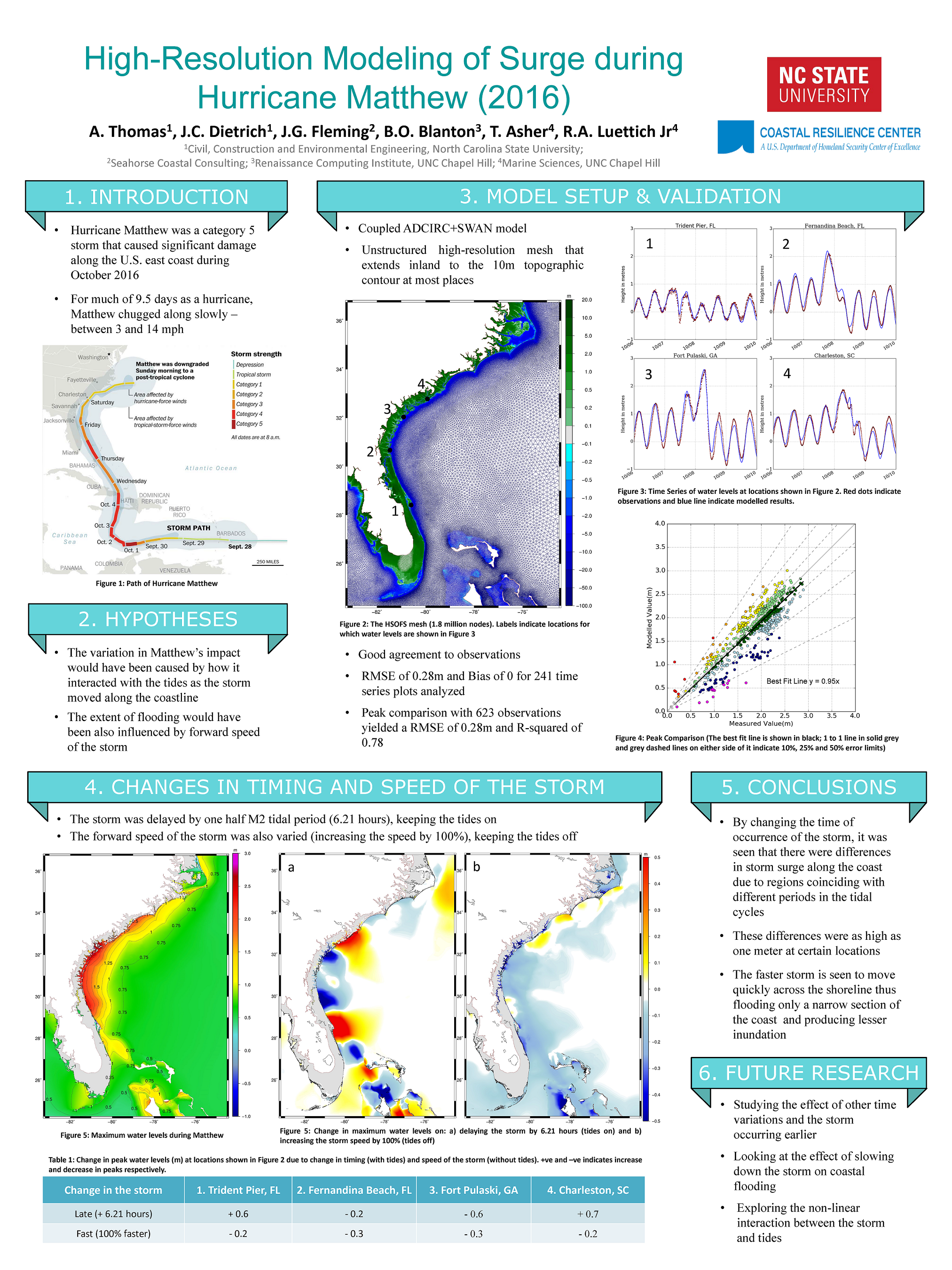
High-Resolution Modelling of Surge during Hurricane Matthew (2016).
Nelson and Ajimon win Student Poster Awards
MS student Nelson Tull won First Place in the Student Poster Competition at the EWC Research Symposium. Nelson described his research to enhance resolution of coastal flooding forecasts for decision support.
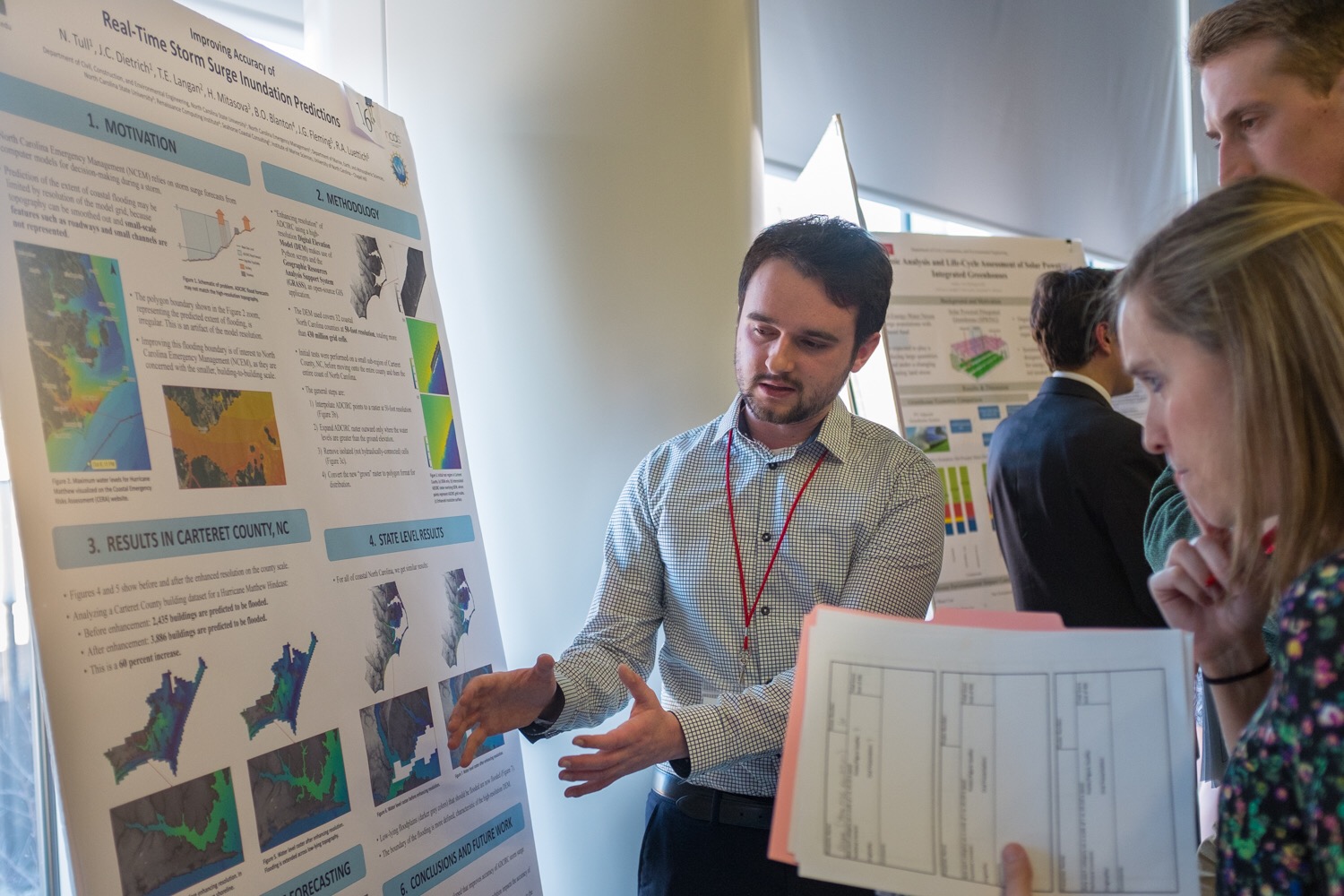
PhD student Ajimon Thomas won Honorable Mention. Ajimon described his research to quantify interactions between tides and storm surge along the U.S. southeast coast during Hurricane Matthew.
This event is an annual showcase for research in our Environmental, Water Resources, and Coastal (EWC) engineering group, as well as a recruiting event for potential students. Awardees are selected by judges from other academic departments, government agencies, and consulting firms. Students presented their posters to judges and visitors during a poster session, and then finalists presented orally to the entire audience.
Congratulations to Nelson and Ajimon!
Nelson Tull shares his poster with judges at the 2018 EWC Research Symposium.
Posters: EWC Research Symposium 2018
N Tull, JC Dietrich, TE Langan, H Mitasova, BO Blanton, JG Fleming, RA Luettich. “Improving Accuracy of Real-Time Storm Surge Inundation Predictions.” Environmental, Water Resources, and Coastal Engineering Research Symposium, North Carolina State University, 2 March 2018.
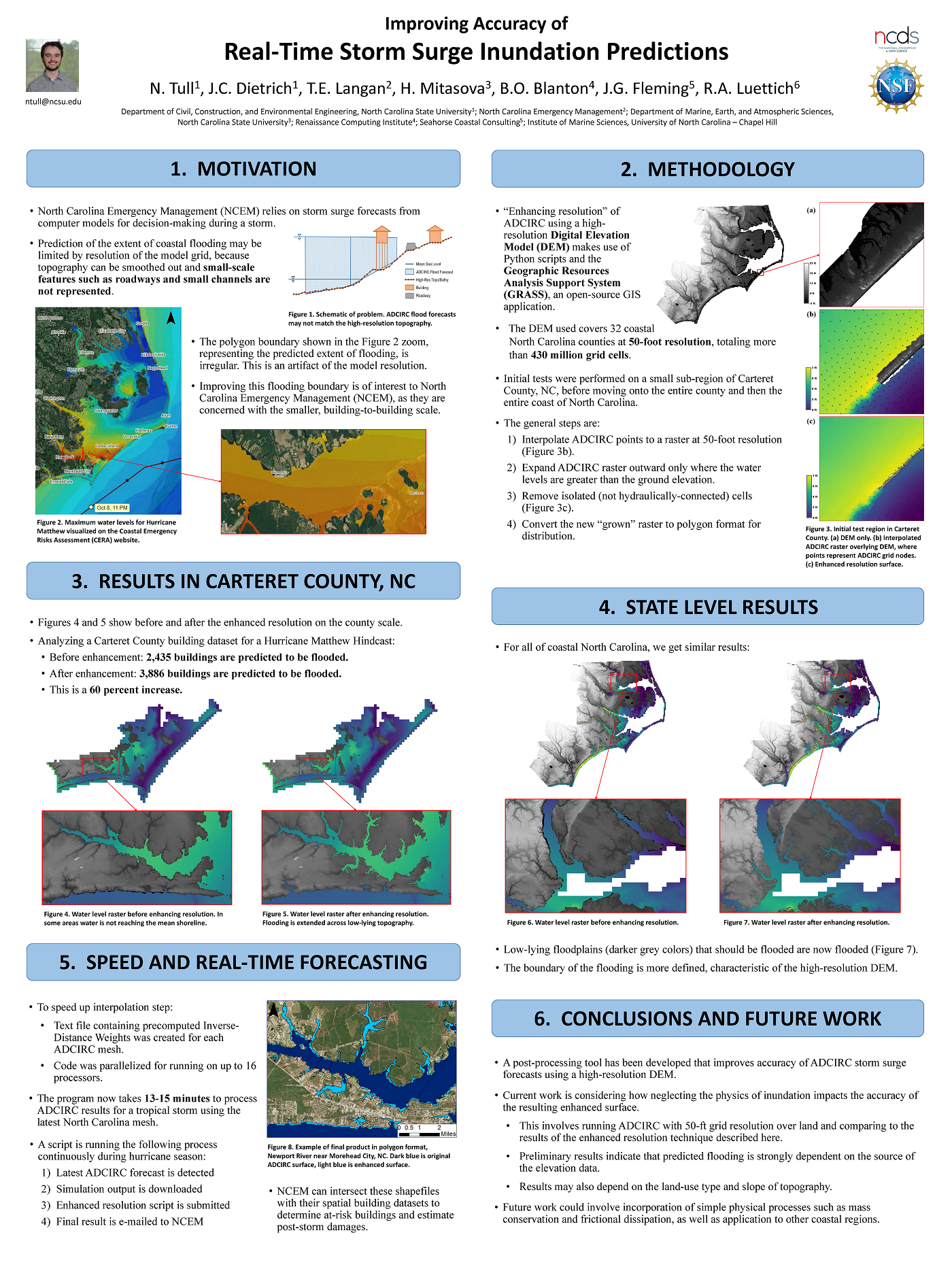
Improving Accuracy of Real-Time Storm Surge Inundation Predictions.
Posters: 2018 Ocean Sciences Meeting
A Gharagozlou, JC Dietrich, MF Overton, A Karanci. “Modeling the Erosion on Hatteras Island During Hurricane Isabel: Resolution Requirements for Coupling with Circulation-Wave Models.” 2018 Ocean Sciences Meeting, Portland, Oregon, 11-16 February 2018.
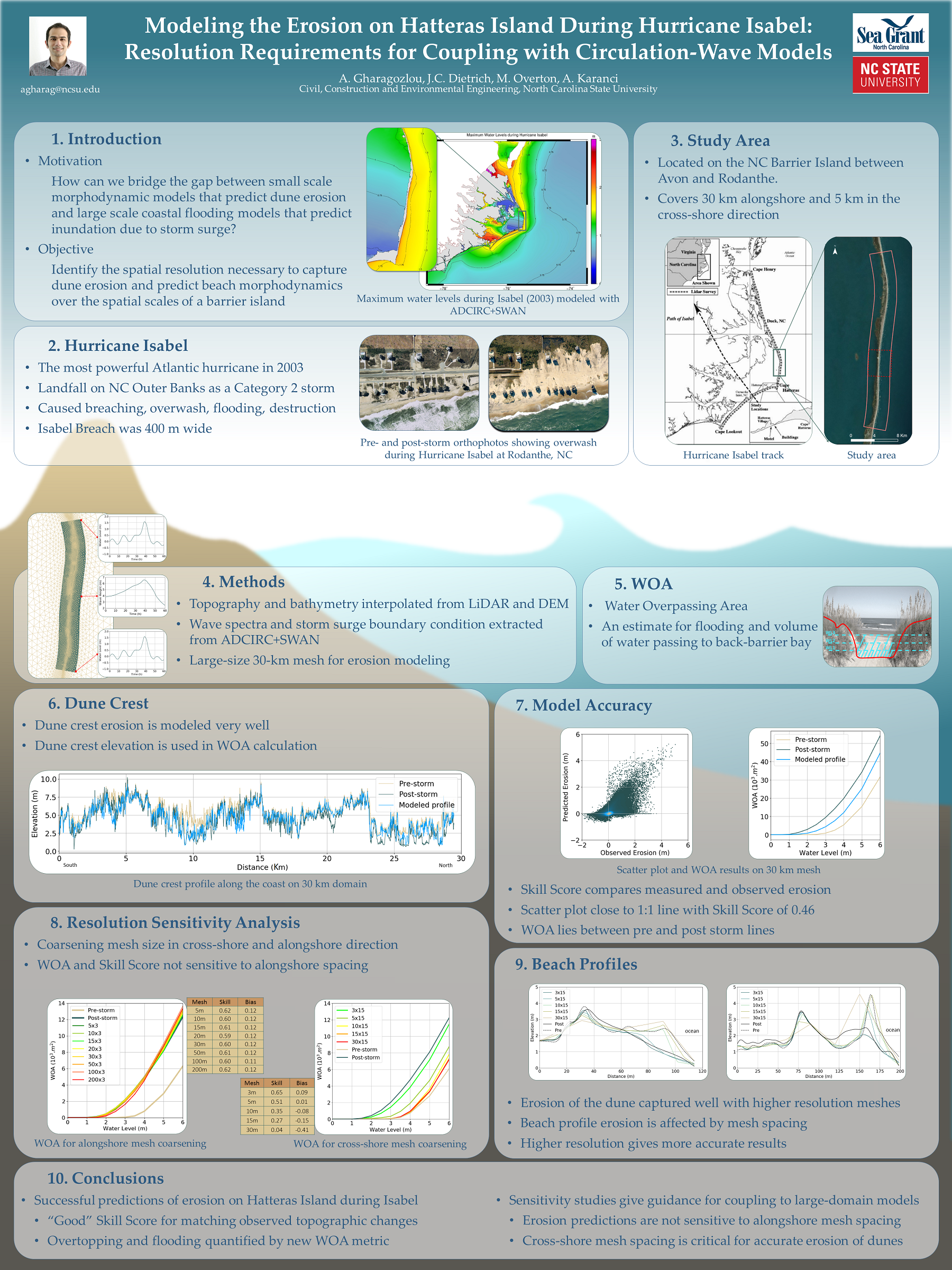
Modeling the Erosion on Hatteras Island During Hurricane Isabel
R Cyriac, JC Dietrich, A Fathi, C Dawson, K Dresback, CA Blain, M Bilskie, S Hagen, H Graber. “Wind Effects on the Choctawhatchee River Plume at Destin Inlet, Florida.” 2018 Ocean Sciences Meeting, Portland, Oregon, 11-16 February 2018.
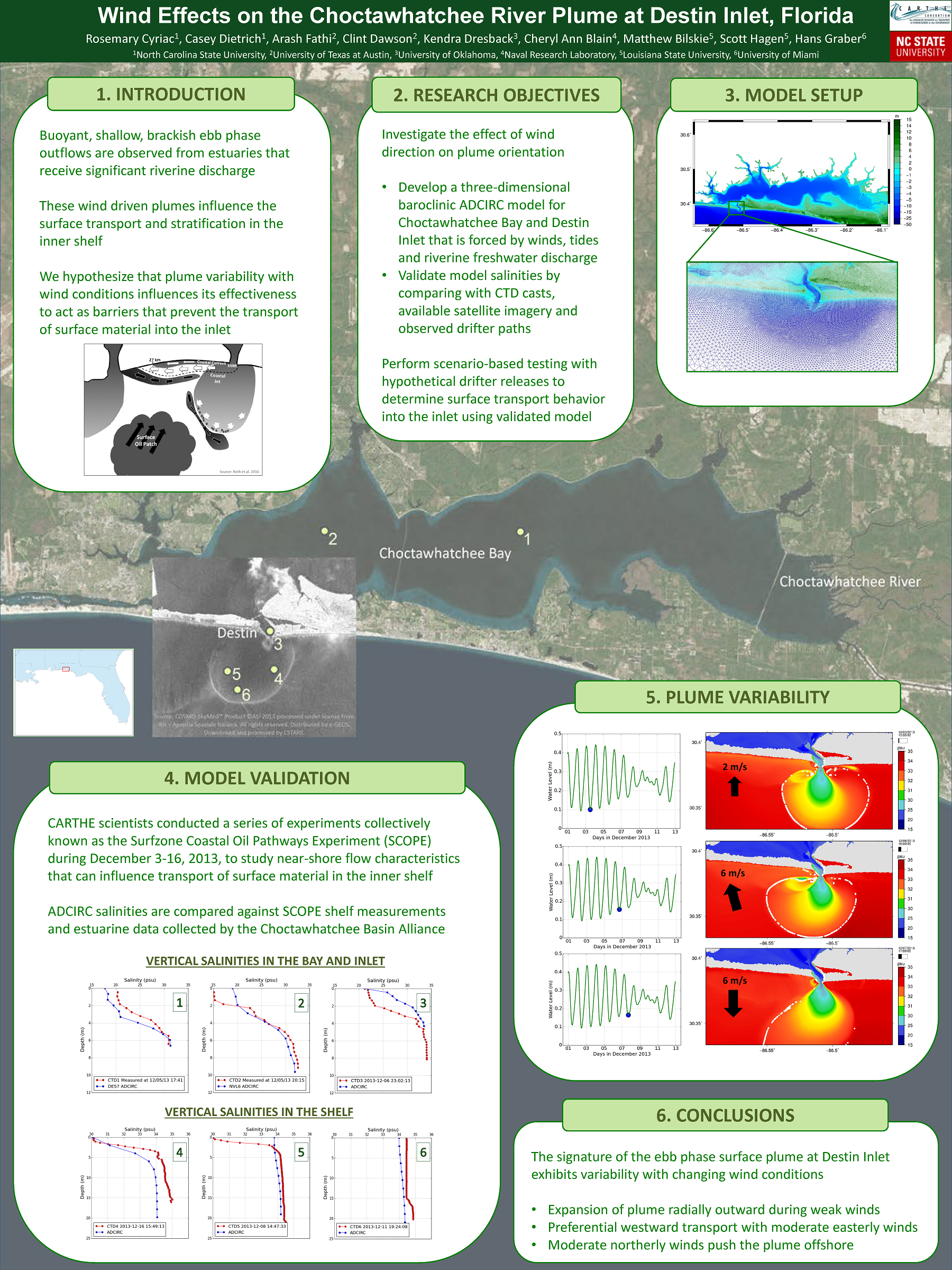
Wind Effects on the Choctawhatchee River Plume at Destin Inlet, Florida
Sensitivity of Storm Surge Predictions to Atmospheric Forcing during Hurricane Isaac
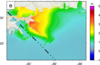 Storm surge and overland flooding can be predicted with computational models at high levels of resolution. To improve efficiency in forecasting applications, surge models often use atmospheric forcing from parametric vortex models, which represent the surface pressures and wind fields with a few storm parameters. The future of storm surge prediction could involve real-time coupling of surge and full-physics atmospheric models; thus, their accuracies must be understood in a real hurricane scenario. The authors compare predictions from a parametric vortex model (using forecast tracks from the National Hurricane Center) and a full-physics coupled atmosphere-wave-ocean model during Hurricane Isaac (2012). The predictions are then applied within a tightly coupled, wave and surge modeling system describing the northern Gulf of Mexico and the floodplains of southwest Louisiana. It is shown that, in a hindcast scenario, a parametric vortex model can outperform a data-assimilated wind product, and given reasonable forecast advisories, a parametric vortex model gives reasonable surge forecasts. However, forecasts using a full-physics coupled model outperformed the forecast advisories and improved surge forecasts. Both approaches are valuable for forecasting the coastal impacts associated with tropical cyclones
Climate Change Effects on Flooding During Hurricane Sandy
 Hurricane Sandy devastated the Northeast US coastline in 2012. In New York City, it caused power outages that affected nearly 2 million people, forced evacuations of 6500 patients from hospitals and nursing homes, prevented 1.1 million children from attending school for a week, and disrupted the daily travel of about 11 million commuters. Many of these impacts were related to flooding of critical infrastructure, including nearly 90,000 buildings, and more than $5 billion in damages in the mass transit system. The maximum observed water level at the tidal gauge located at the southern tip of Manhattan was 5.3 m above the station datum and 2.8 m above the expected tide. This additional water, known as storm surge, was pushed from the open sea by strong winds during the storm. Sandy was one of several recent storms to cause flooding along the US Gulf and Atlantic coasts, including Katrina and Rita (2005), Gustav and Ike (2008), Irene (2011), Isaac (2012), and Hermine and Matthew (2016). Climatic changes are causing these storms to be larger and more intense, last longer, and move farther northward. Their impacts will be more severe to communities in coastal regions in the future.