
Category Archives: Projects
Comparative Assessment of Total Water Levels for Coastal Military Facility Readiness and Resilience using Numerical Models
This project will compare numerical and empirical model predictions of coastal flooding at representative military facilities, with the goal of identifying the best practice for any facility. Unlike previous efforts, this project will consider a suite of open-source numerical models, which include all of the relevant physics that contribute to total water levels, such as sea level rise, tides, wind-induced surge, wave runup, and infragravity motions. Total water levels will be predicted for selected tropical cyclones and storm events with varying tracks and intensities, to represent the full range of possible forcings at each location. Locations include facilities on the U.S. Gulf and Atlantic coasts and in the Pacific Ocean to represent the full range of coastal geographies. Model performance will be compared with respect to inundation depths, timing and duration of flooding at each installation, as well as computational costs. This comparative assessment will inform the use of the most appropriate model in terms of resolved physics and computational effort for predictions of total water levels at any facility, thus enhancing military installation readiness and resilience, in direct support of DoD and ESTCP priorities.
JA Puleo, JC Dietrich, J Figlus, K Nederhoff, F Shi, SM Smallegan, CD Storlazzi, A van Dongeren. “Comparative assessment of total water levels for coastal military facility readiness and resilience using numerical models.” Department of Defense, Environmental Security Technology Certificate Program, 2022/04/13 to 2026/04/12, $2,177,000 (Dietrich: $346,000).
Webinar: ECU
Conference: EWC Symposium 2022
Poster: Spring 2022 Conferences
JF Gorski, JC Dietrich, RA Luettich, MV Bilskie, D Passeri, RC Mickey. “Toward deterministic, dynamic model forecasts of storm-driven erosion.” 2022 Ocean Sciences Meeting, Virtual Meeting, 2 March 2022.
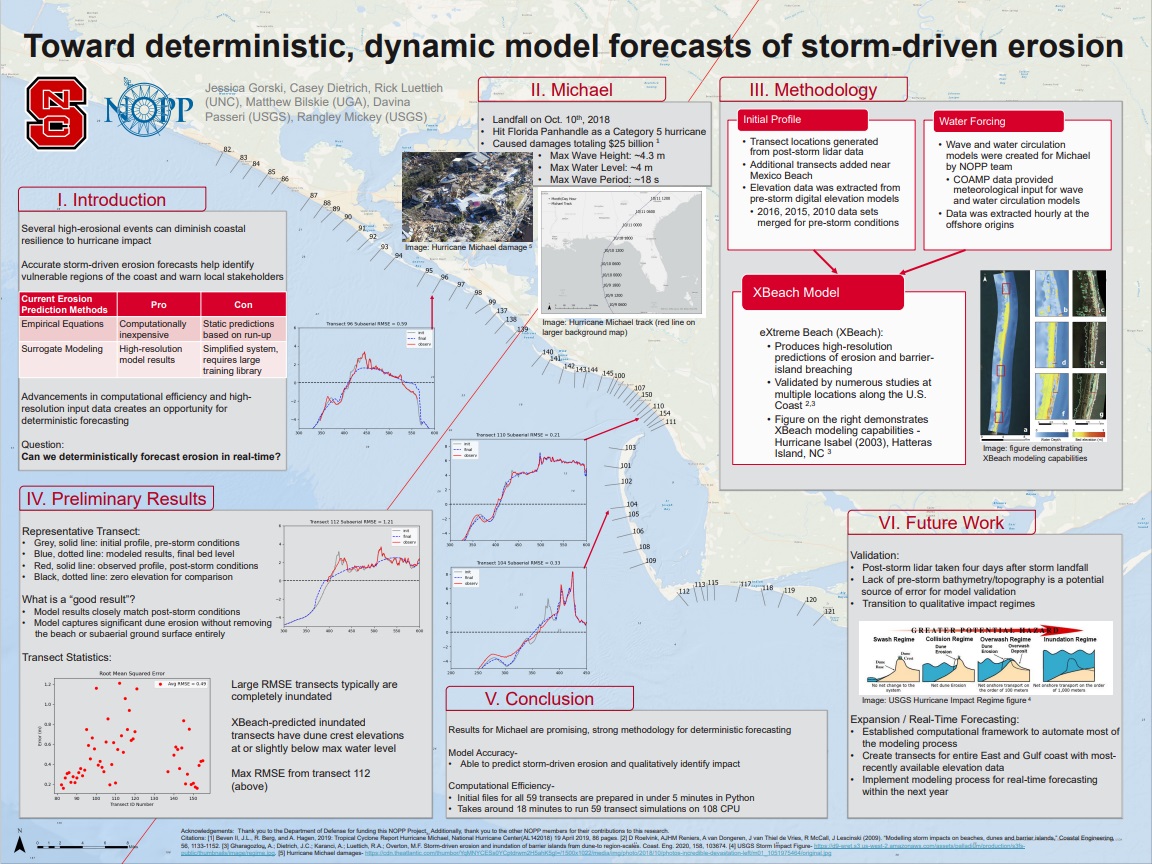
JF Gorski, JC Dietrich, RA Luettich, MV Bilskie, D Passeri, RC Mickey. “Toward deterministic, dynamic model forecasts of storm-driven erosion.” Environmental, Water Resources, and Coastal Engineering Research Symposium, North Carolina State University, 4 March 2022.
Toward deterministic, dynamic forecasts of storm-driven erosion
Virtual Conference: 2022 Ocean Sciences Meeting
Adaptation Pathways for Climate Change Resilience on Barrier Islands
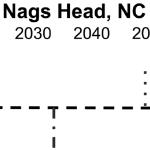 Coastal communities throughout the world will be faced with policy decisions that affect their resilience to climate change, sea level rise, and associated impacts. Adaptation pathways, a holistic approach to policy development, may be an ideal framework for municipalities to consider in low-lying, dynamic environments such as barrier islands. Adaptation pathways identify hypothetical future timelines whereby communities adopt a different policy in response to new environmental conditions. This takes into account changing conditions and resulting hazards that exceed a threshold agreed upon by the community. In this paper, we focus on barrier island communities and give an overview of adaptation pathway methodologies, highlight several common policies considered to increase resilience, review how coastal scientists have thus far contributed to such methods, and discuss specific research agendas that could aid in future implementations. Although the use of adaptation pathways is still in its early stages in many coastal communities, the success of the process is dependent on contributions from both quantitative hazard research and consistent engagement with stakeholders in an iterative co-development of prioritized policy trajectories. Scientific needs include: better understanding of future hazards due to climate change and sea level rise, better predictions of time-dependent processes such as barrier island response to human alterations to natural coastal defense systems, and improved communication between physical scientists, social scientists, managers, and stakeholders.
Improved Wave Predictions with ST6 Physics and ADCIRC+SWAN
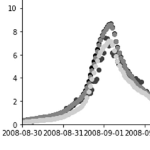 The Simulating WAves Nearshore (SWAN, Booij et al. 1999) model is used widely for predictions of waves in coastal regions. Like other spectral wave models, SWAN uses parameterizations to represent wave evolution due to sources (e.g. wind), sinks (e.g. whitecapping, bottom friction, depth-limited breaking), and resonance (e.g. quadruplet and triad wave-wave interactions). Each parameterization is based typically on observational data to represent the transfer of energy to, from, and between waves. It is necessary for each term to represent its physical process, but it is also necessary for the terms to be calibrated collectively to represent their combined effects on wave evolution. The calibrated wave predictions can then be coupled with models for circulation and coastal flooding, e.g. ADvanced CIRCulation (ADCIRC, Luettich et al. 1992).
SWAN release version 41.20 included a new “package” of wave physics (referred to as ST6 physics). This package has new parameterizations of wind input, whitecapping, swell dissipation, wind speed scaling, and other processes (Rogers et al. 2012). The ST6 physics have been adopted by other wave models (e.g. NOAA’s WaveWatch III, Liu et al. 2019), and it may become the preferred physics package for SWAN. However, because the ST6 physics package has changes to so many parameterizations, it is necessary to quantify its effects on wave predictions. Recent studies (e.g. Aydogan and Ayat 2021) have demonstrated the benefits of using the ST6 physics in the standalone version of SWAN, but its effects have not been quantified for the coupled ADCIRC+SWAN (Dietrich et al. 2011a), which is used for real-time forecasts during impending storms. Do the ST6 physics improve the ADCIRC+SWAN wave predictions?