
Category Archives: Models
Deterministic, Dynamic Model Forecasts of Storm‑Driven Coastal Erosion
 The U.S. Atlantic and Gulf of Mexico coasts are vulnerable to storms, which can cause significant erosion of beaches and dunes that protect coastal communities. Real-time forecasts of storm-driven erosion are useful for decision support, but they are limited due to demands for computational resources and uncertainties in dynamic coastal systems and storm forcings. Current methods for coastal change forecasts are based on empirical calculations for wave run-up and conceptual models for erosion, which do not represent sediment transport and morphological change during the storm. However, with continued advancements in high-resolution geospatial data and computational efficiencies, there is an opportunity to apply morphodynamic models for forecasts of beach and dune erosion as a storm approaches the coast. In this study, we implement a forecast system based on a deterministic, dynamic model. The morphodynamic model is initialized with digital elevation models of the most up-to-date conditions and forced with hydrodynamics from wave and circulation model forecasts, and its predictions are categorized based on impact to the primary dune, defined in this study as the first ridge of sand landward of the beach. Results are compared spatially to the observed post-storm topography using changes to dune crest elevations and volumes, and temporally to the predicted total water level at the forecasted moment of dune impact.
Nahruma wins People’s Choice Award at EWC Symposium
Nahruma Pieu won the People’s Choice Award at the Environmental, Water Resources, and Coastal (EWC) Engineering Graduate Research Symposium, hosted by the Department of Civil, Construction, and Environmental Engineering (CCEE) at NC State University. She was one of two presenters to win the award, which was voted by attendees at the symposium.
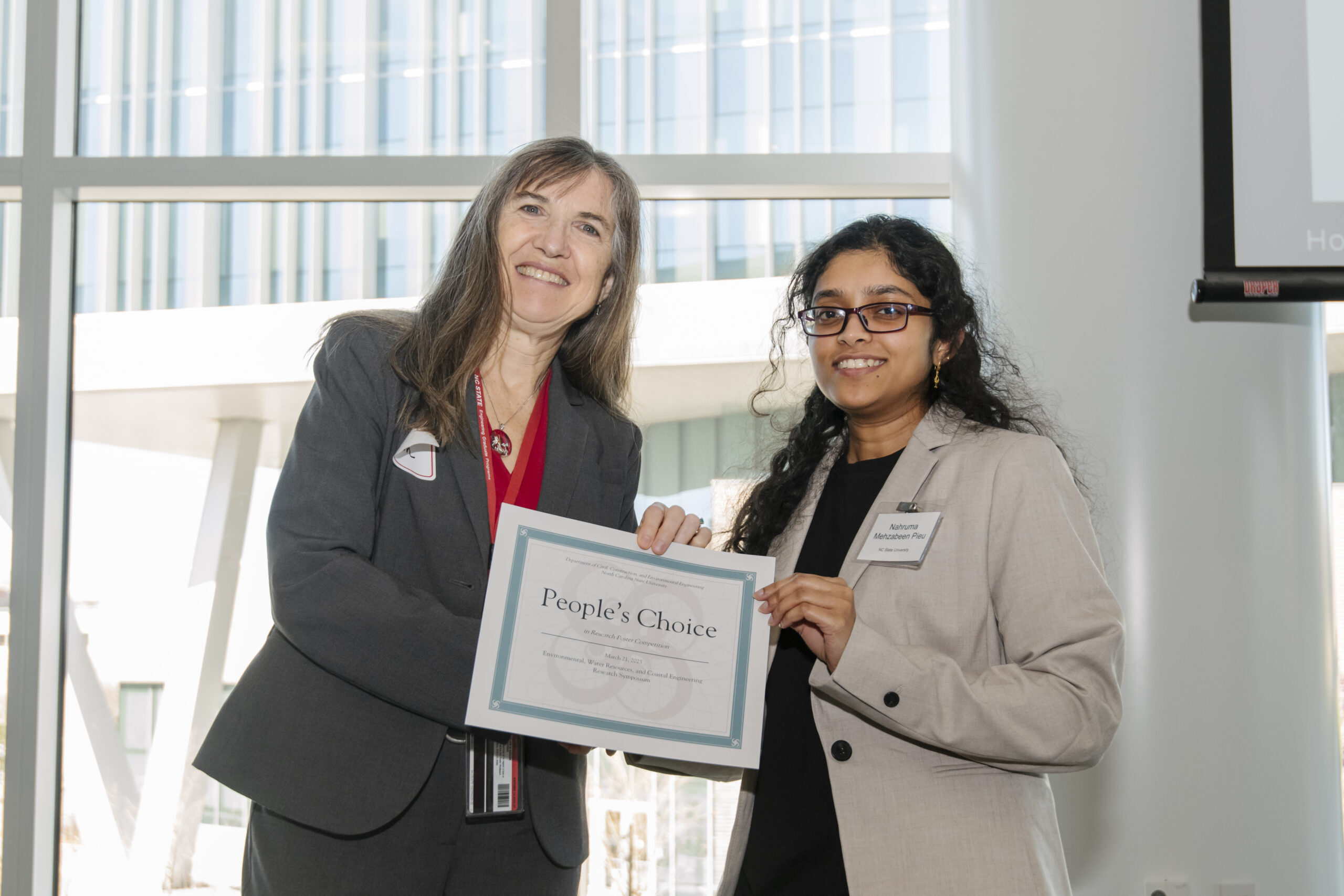
Nahruma received the People’s Choice Award from CCEE Department Head, Dr. Gibson.
“I’m thankful that my work was well received by the community,” Nahruma said. “I’m especially grateful to my advisor, Dr. Casey Dietrich, whose guidance and support made this possible. I’m also thankful to the National Oceanographic Partnership Program (NOPP) for funding my work on predicting coastal dune erosion, which will be necessary given our recent climate change scenario, as storms increase in frequency and intensity.”
Congratulations to Nahruma!
Conference: EWC Symposium 2025
Posters: EWC Symposium 2025
NK Arrigo, JC Dietrich, TC Massey. “Spatial controls and efficiency gains within a spectral wave model.” Environmental, Water Resources, and Coastal Engineering Graduate Research Symposium, North Carolina State University, 21 Mar 2025.
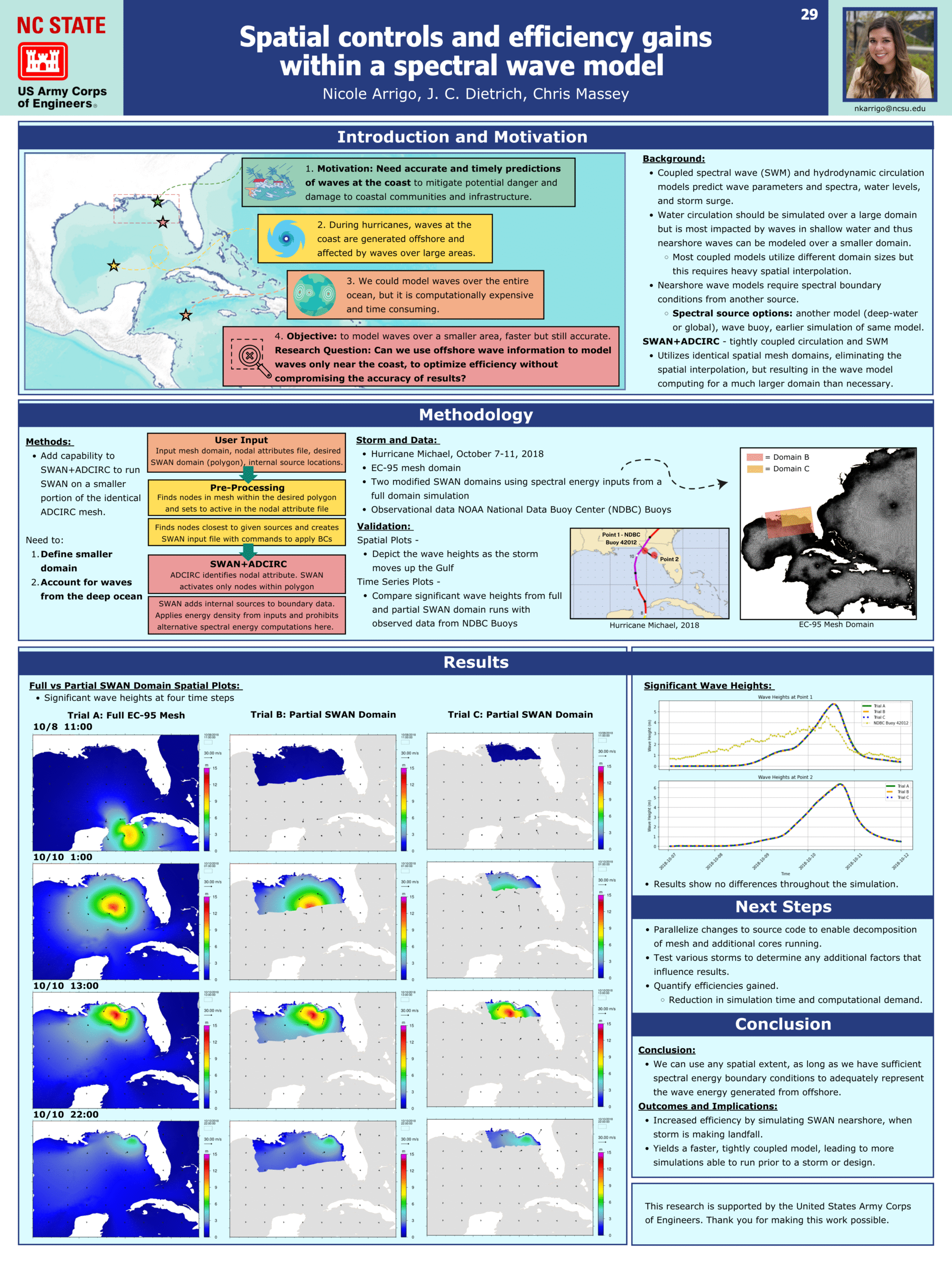
Spatial controls and efficiency gains within a spectral wave model.

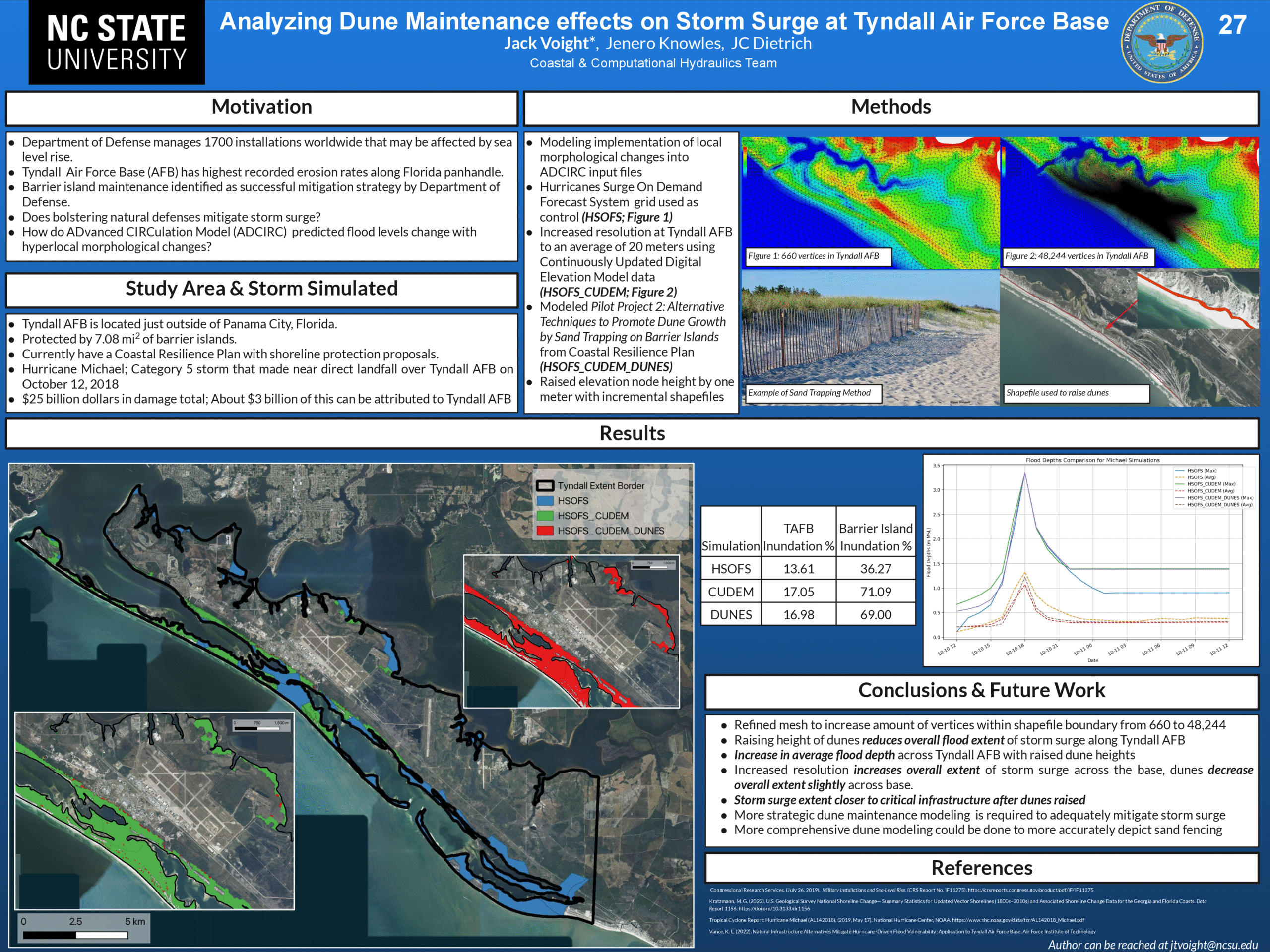
Analyzing Dune Maintenance effects on Storm Surge at Tyndall Air Force Base.

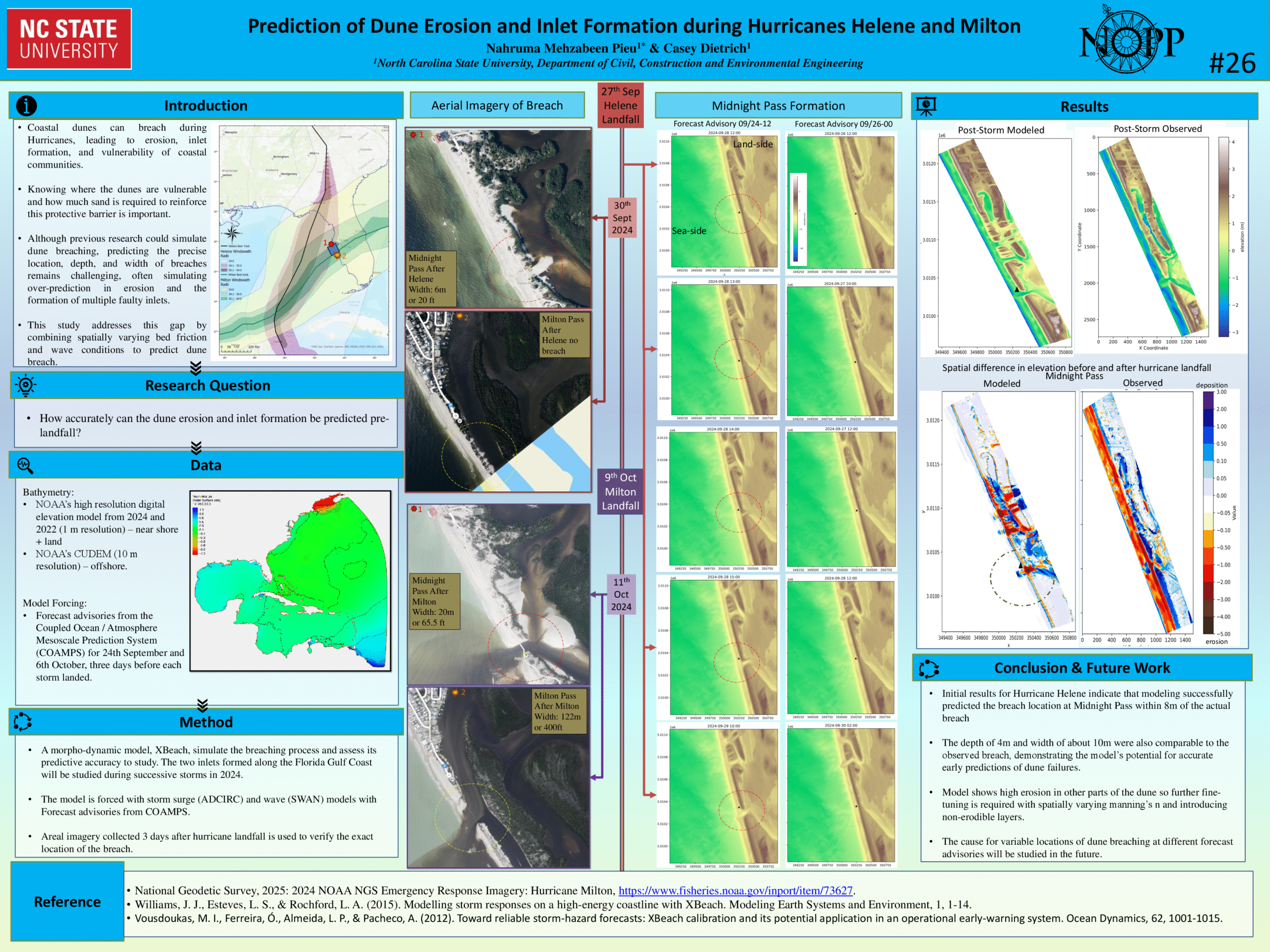
Prediction of Dune Erosion and Inlet Formation during Hurricanes Helene and Milton.

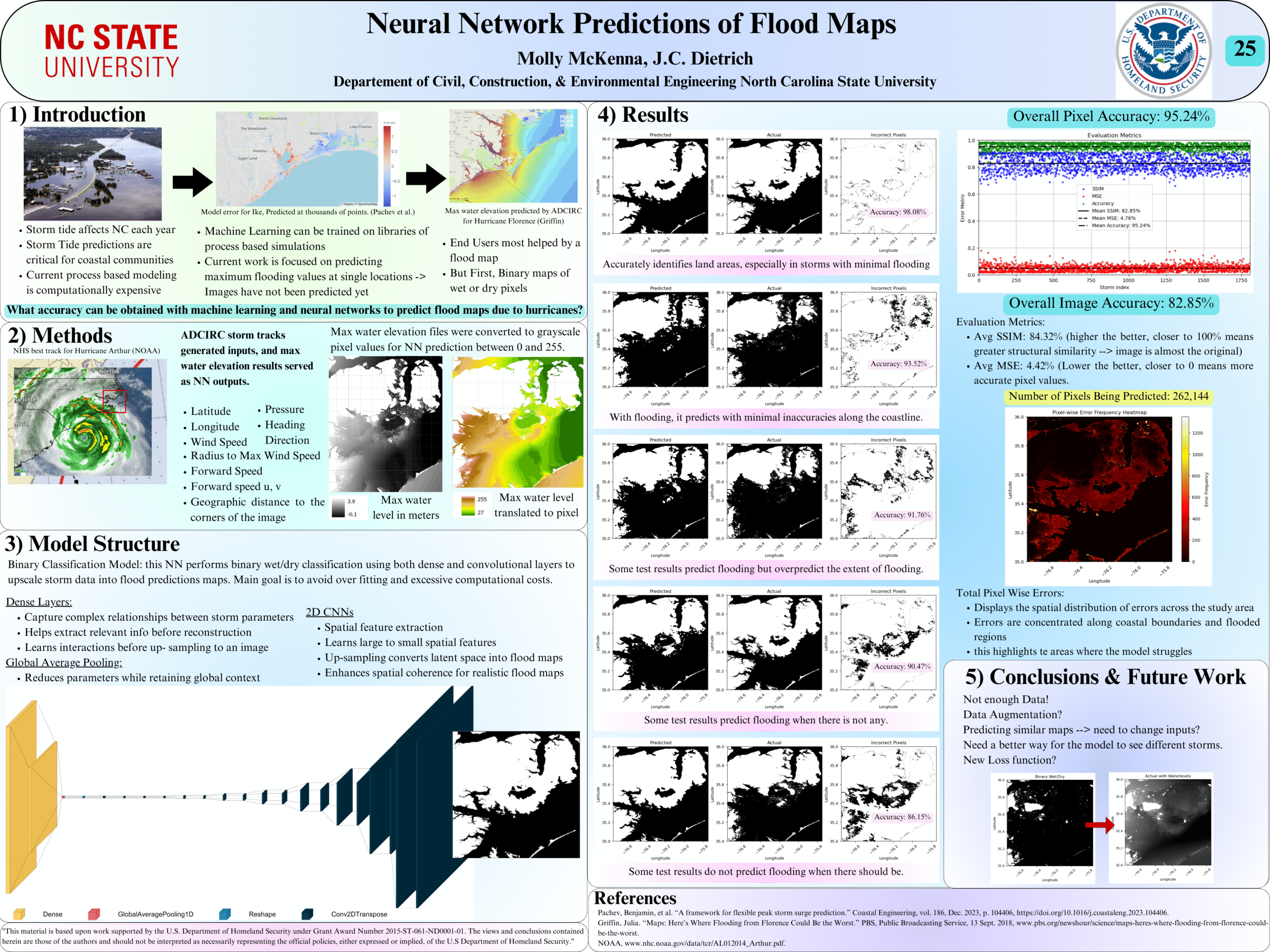
Neural Network Predictions of Flood Maps
Invited Seminar: Nagoya University
News: Erosion Forecast Framework
2025/01/22 – NCSU Civil, Construction, and Environmental Engineering
New technology forecasts beach and dune erosion before hurricanes strike
New technology forecasts beach and dune erosion before hurricanes strike

“Physics-based models can predict how the dune may be lowered, and how much water may flood behind it,” said Jess Gorski (MS 2023), who worked with Professor Casey Dietrich on the project. “Our forecasts can provide information about coastal change to decision makers during a storm.”
In collaboration with the USGS, CCEE researchers developed a framework for running the eXtreme Beach (XBeach) model in real time. The U.S. Gulf and Atlantic coasts are described with thousands of transects, which quantify the offshore depths and the shape of the beach and dune at intervals of 500 m to 2 km along the coast. When a storm approaches, the framework can select the transects that may be affected, and then run a few hundred simulations of the coastal erosion.
News: NC State on the Coast
2024/10/08 – NC State
NC State faculty and students are helping to keep coastal communities healthy through the North Carolina Center for Coastal Algae, People and Environment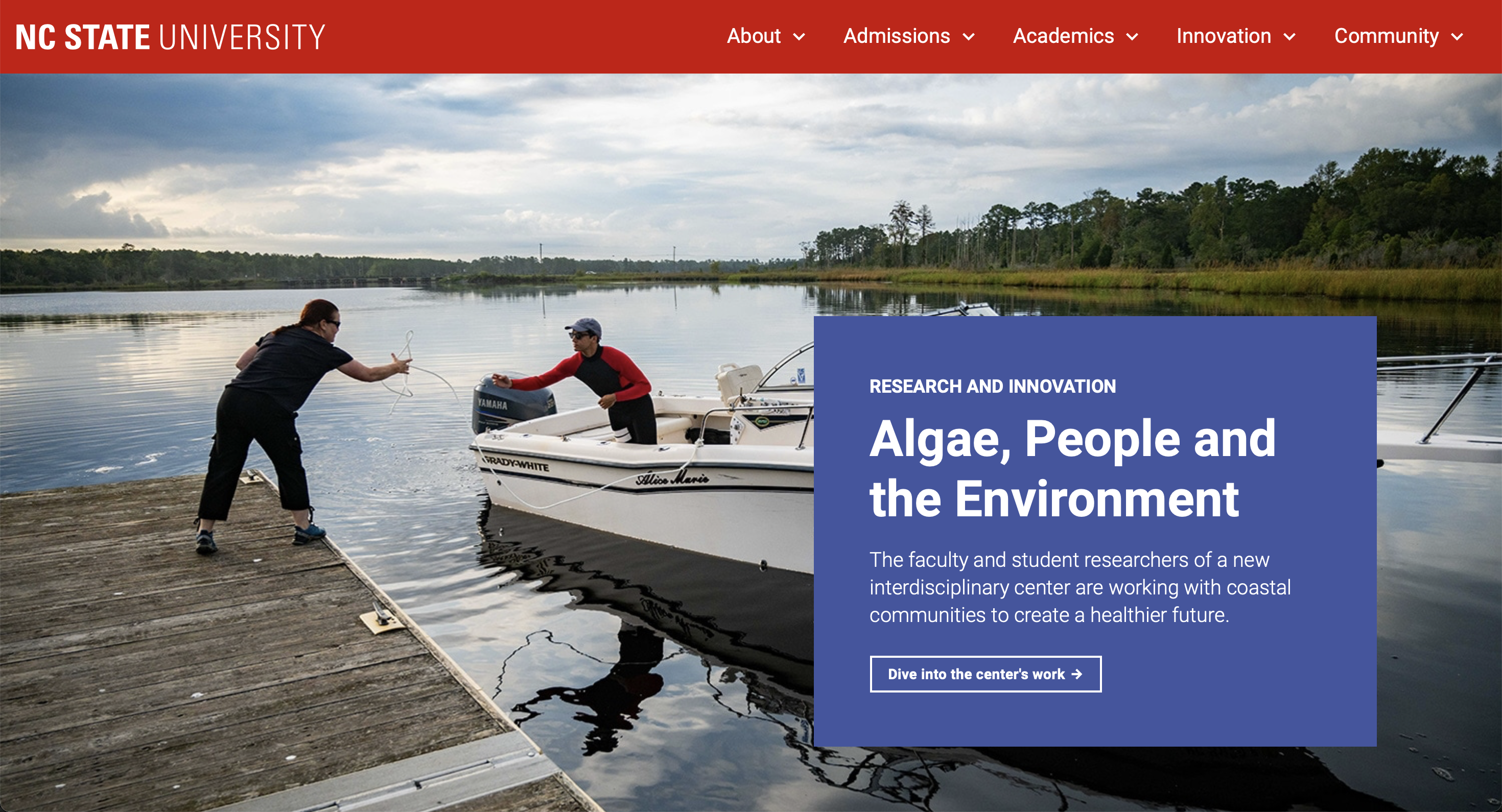
NC State faculty and students are helping to keep coastal communities healthy through the North Carolina Center for Coastal Algae, People and Environment
NC C-CAPE (and our fearless leader Astrid Schnetzer) were featured on the NC State homepage.
NC C-CAPE was featured on the NC State homepage. Lots of information and quotes from folks in the center, including great photos of our colleagues in the field and laboratory. It is fun to contribute to such a large, meaningful research effort.
“In the past few months, we’ve officially started to sample as NC C-CAPE,” [Barrett] Rose said. “It was a shock to see the magnitude of how much we were actually studying. It went from a small pilot study to a huge center effort.”
Data collection and analysis is only the first part of the work NC C-CAPE seeks to do. While harmful algal blooms are common in fresh waters across the U.S. and the world, major data gaps around the issue exist. [Astrid] Schnetzer’s data will inform NC C-CAPE’s other two projects, which focus on predicting the health risks of toxic algal blooms on mammals and humans, as well as considering how factors like climate change will affect future toxin levels in water and seafood.
“The most exciting aspect of NC C-CAPE for me is that the research doesn’t end where my expertise ends,” said Schnetzer. “What we learn from the field about algal toxins is handed to the next team to look at the bigger picture on the ecosystem level and in connection to human health.”