Category Archives: About Us
News: Sea Change
Working with one of North Carolina’s most valuable resources
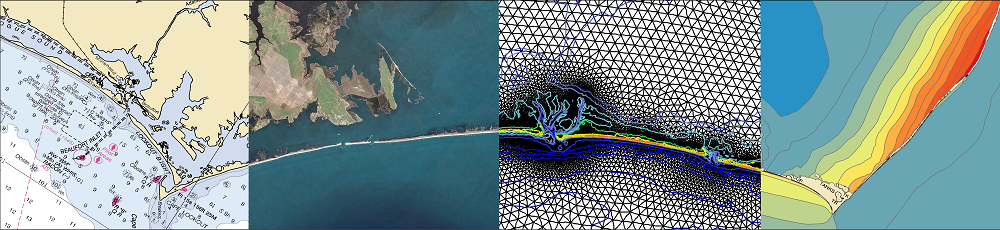
Dietrich came to NC State with a wealth of experience in coastal modeling, most of it done along the Gulf Coast of the United States. He will soon begin a project with the National Oceanic and Atmospheric Administration to model North Carolina’s coast. Dietrich is part of a research community using a computer model called ADCIRC to predict everything from storm surge and flooding to the feasibility of dredging, or where material floating in the ocean might end up.
When a hurricane is bearing down on the coastline, running the models quickly is of the essence. But the faster the model runs, the less accurate it is. Improving the models so that the time and accuracy trade-off isn’t as sharp is part of Dietrich’s work.
So is figuring out the best ways to visualize the results and get the modeling information to local emergency management officials along the coast so that they can use it.
“It doesn’t help anybody if we are doing this in an empty room somewhere and not sharing the results with the community and sharing them in a way that will maximize their use and maximize their impact,” he said.
News: Hazard Resilience in Coastal Communities
Coastal Science Serves North Carolina: Sea Grant Funds New Research Projects
Using a high-resolution modeling system, the researchers will expand the utility and accuracy of wave, storm-surge and flooding forecast guidance available to emergency managers in North Carolina. The accurate prediction of these elements is essential for the safety of people and property.
News: Welcome to NC State
Coastal Engineering Expert Casey Dietrich Joins CCEE Faculty
Dietrich’s work addresses coastal processes, ranging from hurricanes to sediment transport, both of which can transform regions, albeit at rates ranging from hours to many years. Dietrich develops models to describe the oceans in deep water and the nearshore and then validates them against the best available measurements and knowledge of natural behavior. These models lead to improved understanding of the natural and built environments. His models have been used for levee design in New Orleans by the U.S. Army Corps of Engineers and for floodplain risk assessment along the Gulf and Atlantic coasts by the Federal Emergency Management Agency. He has also applied his models to forecast coastal flooding during recent storms including Hurricane Isaac (2012) and oil transport following the BP spill in 2010. He plans to extend his models for civil engineering applications along the North Carolina coastline.
Also click here to see the profile of Casey Dietrich in the college’s list of new faculty.
News: Model Predictions of Surface Oil Transport
Study Evaluates Accuracy of 2010 Model Predictions for Oil Spill Movement
During the 2010 oil spill, emergency responders needed forecasts of where oil would go given different scenarios and weather conditions, not just information of current oil location. Forecasts had to account for this first-time situation of oil coming from a deep water source and thus, “the important processes that contribute to oil movement in deep water, on the continental shelf, and within the complex nearshore environment.” Forecasters used the coupled SWAN (Simulating Waves Nearshore) and ADCIRC (Advanced CIRCulation) models to simulate currents that accounted for tides, rivers, winds, and waves. They adjusted their models with data from Lagrangian particle tracking to simulate “short-term (less than 1 week) oil movement.”
News: Modeling of Hydrocarbons in the Environment
News: Large-Scale Simulations of Coastal Flooding
UT research group uses math, simulations to analyze hurricanes
by Mark Carrion
Casey Dietrich is one of 14 researchers besides Dawson who works in the research group. He said having access to Stampede, UT’s new and powerful supercomputer, is important for the simulations the group runs.
“We’re very lucky we get access to one of the largest supercomputers in the world,” Dietrich said. “That opens the door for us to run larger, more interesting problems.”
Dietrich said the models they run use calculations from Stampede that allow them to analyze changes in an area as small as 20 meters.
“We can really see how the flooding is affecting the environment,” Dietrich said.
News: Forecasting of Hurricane Isaac
Supercomputers help New Orleans prepare for Hurricane Isaac
Computing advances since Katrina have helped the city plan better on the storm surge, for one
About the time of Katrina, the computer models “were much coarser and had minimum resolutions of only 100-200 meters,” said Casey Dietrich, a post-doctoral researcher at the Institute for Computational Engineering and Sciences at University of Texas in Austin.
Dietrich has been running compute models at the Texas Advanced Computing Center at the University of Texas to assess the impact of the storm surge on Texas.
Emergency planners in both states take the data generated by the university researchers and incorporate it into geographic information systems.
“They can look down at neighborhood scale and say ‘on this street along the levy we’re going to have water this high,’ and plan accordingly,” Dietrich said.
Comparing the capability today with that at the time of Katrina, Dietrich said: “I think we have a very strong understanding of how hurricane wave storm develop and how they can threaten a coastal environment.”
Also see local coverage by the Institute for Computational Engineering and Sciences.