Updates to Spectral Propagation Velocities

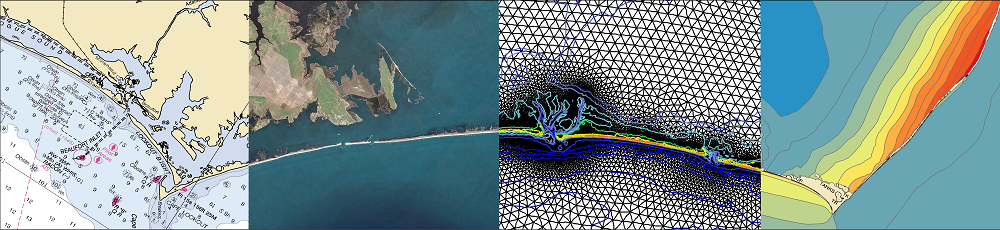
As we have progressed with the coupling of SWAN+ADCIRC, one persistent question has been how SWAN handles the spectral propagation velocities in regions with relatively-coarse mesh resolution. In these regions, energy was focused unrealistically at a single mesh vertex, causing the significant wave heights to become non-physical.

The preferred solution is always to increase the mesh resolution, to better represent the evolution of waves due to changes in bathymetric depths and/or ambient currents. But this preferred solution is not always feasible, especially when the non-physical behavior is occurring far from the region of interest.

Now this question has been addressed in a robust manner with the latest version of SWAN (starting with v41.01B) and SWAN+ADCIRC (starting with v53.00). Previous techniques are now outdated. This post will describe this new technique, and demonstrate its performance on a few test cases.
Continue reading

Mapping and Visualization of Coastal Flood Forecasts for Decision Support

The goal of this proposed research is to enable data-driven decision-making for coastal communities during storm events. The ADCIRC forecast data will be connected to geospatial databases for use by emergency managers to consider inundation and damages during storm scenarios. The critical objectives of this proposed research are (1) downscaling the model forecast data to the resolution of geospatial datasets used for decision support, (2) assessing the implications of this downscaling on forecast accuracy, and (3) connecting these technologies with an end user, specifically the NC Emergency Management.

JC Dietrich. “Mapping and Visualization of Coastal Flood Forecasts for Decision Support.” National Consortium for Data Science, Data Fellows, 2016/07/01 to 2017/06/30, $50,000 (Dietrich: $50,000).

News: Sea Grant Research Tackles Important Issues

ncsg2016/05/18 – NC Sea Grant Coastwatch Currents
Considering Coastal Questions: Sea Grant Research Tackles Important Issues

Beach erosion during storm events can devastate the natural environment and coastal communities. This research team seeks to improve simulations of coastal flooding in regions where the beach erosion is highly dynamic. Such simulations are used in North Carolina and elsewhere for designing buildings, establishing flood insurance rates, and supporting real-time decisions during storm events.

The research will review effects of hurricanes Isabel and Irene on oceanfront and soundside shorelines for Hatteras Island, as well as how storm-induced flooding pushed inland. New predictions will be strengthened as the data are coupled with a beach-erosion model. The team will share results with local- and state-level partners to show connections not only throughout the island system but also related impacts on mainland communities.

Conference: ADCIRC 2016

R Cyriac, JC Dietrich, A Fathi, CN Dawson, KM Dresback, M Bilskie, SC Hagen, H Graber. “Modeling 3D Circulation in the Choctawhatchee Bay and River System.” ADCIRC Users Group Meeting, US Army Engineer Research and Development Center, Coastal and Hydraulics Laboratory, Vicksburg, Mississippi, 05 May 2016.

A Thomas, JC Dietrich, JG Fleming, BO Blanton, RA Luettich Jr. “Optimizing the Placement of Unstructured Mesh Resolution for ADCIRC in Coastal Regions.” ADCIRC Users Group Meeting, US Army Engineer Research and Development Center, Coastal and Hydraulics Laboratory, Vicksburg, Mississippi, 06 May 2016.

Continue reading