
Tag Archives: Casey Dietrich
Seminar: Old Dominion University
The Consortium for Advanced Research on Transport of Hydrocarbon in the Environment (CARTHE)
Building on results from RFP-I, The Consortium for Advanced Research on Transport of Hydrocarbon in the Environment (CARTHE) remains focused on advancing fundamental understanding and modeling of the diverse physical mechanisms responsible for hydrocarbon transport in the Gulf of Mexico environment. An integral part of any informed response to a future event, like the Deepwater Horizon incident, requires knowledge of the distribution of pollutants in the water column and the ability to predict where and how fast the pollutants will spread. This information is also crucial for estimating the pollutants’ impact on the local ecosystem and coastal communities. The overall goal of CARTHE is accurate predictive modeling of pollutant transport from ocean-bottom release to landfall on the beach.
This project specifically identifies two topics, whose understanding is critical for oil spill dispersion prediction; namely (i) the dynamics of transport in the near-surface ocean and lower atmosphere, and (ii) transport in deep-ocean plumes.
Beyond enabling a more efficient and more effective response to a future undersea oil release, broader impacts of this project include education and training of graduate students and postdocs, as well as far-reaching applications of the new scientific insight for navigation using local currents, potential off-shore green energy production, the influence of upper-ocean flows on the ocean’s carbon intake in the climate system, a better representation of ocean and atmosphere heat exchanges for hurricane predictions, and finally for public beach safety and welfare.
News: GoMRI Renews CARTHE
2014/11/15 – GoMRI
Gulf of Mexico Research Initiative Awards $140 Million to Support Research
Gulf of Mexico Research Initiative Awards $140 Million to Support Research
The Gulf of Mexico Research Initiative (GoMRI) has selected 12 research consortia to conduct scientific studies of the impacts of oil, dispersed oil, and dispersant on the Gulf of Mexico ecosystem and public health. These research investments focus on improving our fundamental understanding of the implications of events such as the Macondo well blowout, and on developing improved spill mitigation, oil and gas detection, characterization and remediation technologies. The consortia were chosen following a competitive, merit review process that evaluated research applications submitted to GoMRI in response to its RFP-IV program solicitation.
Through the RFP-IV program, GoMRI is awarding $140 million to support research to be carried out from 2015 through 2017.
2014/11/18 – UM RSMAS
UM Rosenstiel School Scientists Receive Over $29 Million to Study Effects of Crude Oil Spills
Under the leadership of UM Rosenstiel School Professor Tamay Özgökmen, the CARTHE research consortium received over $20 million to continue the research necessary to predict the fate of oil released into the environment to help inform and guide response teams in the event of future oil spills. This second phase of CARTHE, which supports research through 2017, will help scientists develop and improve computational tools to accurately predict the fate of hydrocarbons found in crude oil that are released into the environment, and help to guide risk management and response efforts in mitigation and restoration of the economy and the ecosystem in situations like the Deepwater Horizon oil spill.
“An integral part of any informed response to a future event like the 2010 Deepwater Horizon oil spill requires knowledge of the distribution of pollutants in the water column and the ability to predict where and how fast the pollutants will spread,” said Özgökmen, lead investigator of CARTHE. “This information is also crucial to estimate the pollutants, impact on the local ecosystem and coastal communities.”
News: Developing Storm Surge Visualization
2014/10/29 – NC Sea Grant Coastwatch Currents
Picture This: Developing Storm Surge Visualization
Picture This: Developing Storm Surge Visualization
When a tropical storm or hurricane develops in the open ocean, the National Hurricane Center, known as NHC, issues advisories that anticipate the track and intensity of the wind field. These advisories predict when and where the hurricane is expected to make landfall, even when the storm is far away from the coast.
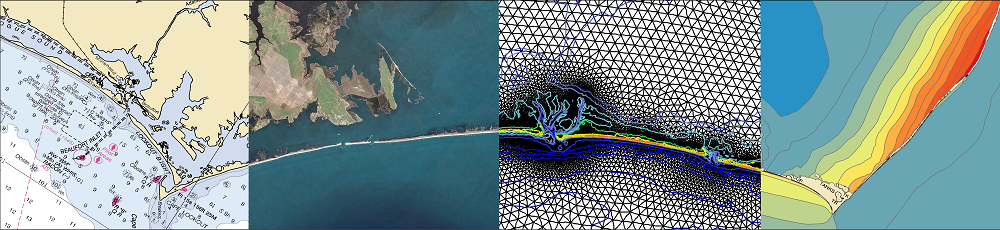
This information serves as an input for the ocean model, which then predicts the water levels or storm surges, and wave heights created by these winds at various locations along our coastline for the coming days. These results will convey a greater meaning to the end user when visualized properly. The chief objective for our project is to improve the communication of these model outputs to the end-user by producing them in popular file formats like that of GIS based shapefiles and KMZ files used in Google Earth.
Seminar: WRCEE
Seminar: Triangle Physical Oceanography
News: Department Video
The following video explains some of our work in the CCEE Department at North Carolina State University, specifically in the focus area of water resources, coastal and environmental engineering.