
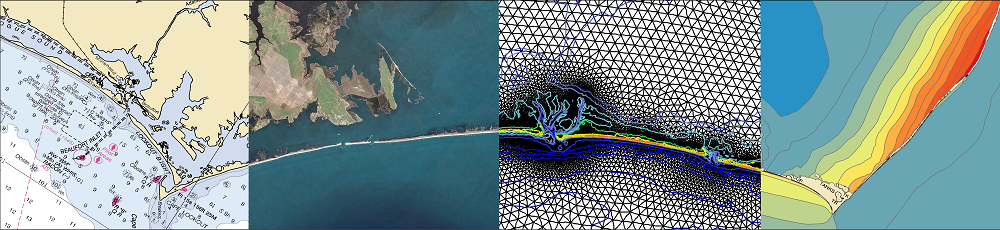
 This thesis develops an artificial intelligence (AI) model to predict peak storm-tides as flood maps with sufficient detail to describe hazards at community scales. Unlike prior approaches that predict storm surge or storm tides at discrete points, this model generates continuous inundation maps that consider the geomorphic controls governing coastal flooding. This model is trained on a library of process-based model simulations spanning a realistic range of storm intensities, forward speeds, track geometries, and landfall locations. Storm-tide maps are predicted for coastal North Carolina, which has a complex coastal region with narrow and wide shelves, barrier islands, inlets, sounds, estuaries, and extensive low-lying floodplains, and which is threatened by landfalling tropical cyclones.
 A central methodological contribution of this work is a physics‑aware tiling and data-augmentation framework that restructures each full-domain simulation into a set of local storm-tide map tiles. Rather than treating each storm as a single, domain‑wide field, the augmentation extracts 64 non-overlapping map tiles (0.25º longitude by 0.25° latitude) that retain geospatial reference, coastal morphology, and hydrodynamic structure. This transformation allows the model to learn how individual storms affect specific regions of the coastline, rather than attempting to generalize across the entire domain at once. The model can see diverse, meaningful examples without introducing distortions from naive image‑based augmentation, expanding the effective training dataset by more than an order of magnitude. The neural‑network architecture fuses two complementary data streams — temporal storm evolution (track, intensity, motion) and static elevation maps encoding pre-storm geomorphology — and is trained using a staged Huber-loss strategy that refines spatial accuracy. Together, these components enable the AI model to learn localized storm‑tide responses while maintaining consistency with the underlying coastal physics.
 Model performance is evaluated across tens of thousands of test tiles spanning the full range of coastal settings and flood responses. The surrogate achieves an overall root-mean-square error (RMSE) = 0.2722 m and maintains strong accuracy across the critical 0 m to 3 m elevation range that governs inundation onset, shoreline overtopping, and inland flood propagation. Elevation-dependent analyses reveal predictable patterns: highest accuracy in persistently dry uplands, moderate accuracy in shallow-water transition zones where small vertical differences strongly influence flooding, and larger errors in sparsely sampled or highly nonlinear regions such as tidal channels. Tile‑level case studies further show how storm approach angle, intensity, and local geomorphology shape prediction fidelity — parallel approaching storms over barrier islands produce larger errors due to enhanced alongshore gradients, whereas perpendicular tracks yield cleaner cross‑shore forcing that the model captures more reliably. These results highlight both the model’s strengths in reproducing coherent surge patterns and its limitations in regions with complex hydrodynamics or limited training representation.
By predicting a map of storm tide in milliseconds, this model enables a framework for real-time hazard assessment, which can be scaled to other coastlines. This model demonstrates that neural-network surrogates can reproduce the essential physics of storm-tide dynamics and be useful during storms.