
Category Archives: NSF DRRG 2024-2026
Poster: ICCE 2026
SG Lott, JC Dietrich, EL Seekamp, AJ Ross, K Nuviae. “Predictions of Storm Surge Flooding for Participatory Transformation of Barrier Islands.” International Conference on Coastal Engineering, Galveston, Texas, 18-22 May 2026.

Predictions of Storm Surge Flooding for Participatory Transformation of Barrier Islands.
News: Winners at CCEE 3MT
2026/04/22 – NCSU Civil, Construction, and Environmental Engineering
Coastal Engineering Student Takes Home 1st Place Prize at 3MT Competition
Coastal Engineering Student Takes Home 1st Place Prize at 3MT Competition

“The work of civil, construction, and environmental engineers impacts communities, and part of the education students receive here is to ensure they are prepared to communicate effectively with stakeholders they will encounter in their careers,” Kittle Autry said.
As for advice to next year’s participants, Lott said to simply have fun with it.
“This has nothing to do with pressure,” Lott said. “It’s a way to step out of your normal day to day and get a different kind of experience.”
News: Spotlight on Sarah Grace
2026/03/16 – Southeast Climate Adaptation Science Center
Researcher Spotlight – Sarah Grace Lott
Researcher Spotlight – Sarah Grace Lott

What results are you finding? Coastal communities on the North Carolina Outer Banks are engaged and want to plan for more resilient futures. By modeling adaptations, such as returning sections of the barrier islands to natural processes or raising the elevation of marshes, we have found that some of the preferred adaptations to reduce flooding actually led to more widespread flooding within communities. We have also found that adaptations have local effects on flooding. Looking to the future, communities will need to coordinate across the entire region to lead to widespread resiliency.
Who will benefit from your research? This research directly benefits the community members of the North Carolina Outer Banks. Our work is grounded in community participation. All of our research questions and modeling scenarios are directly informed by the people who live in vulnerable communities. My goal is that by seeing the potential outcomes of different choices modeled out, these communities will have a powerful new tool to help them envision, discuss, and plan for a more resilient future.
Sarah Grace wins Second Place at EWC Symposium
Sarah Grace Lott won Second Place at the Environmental, Water Resources, and Coastal (EWC) Engineering Graduate Research Symposium, hosted by the Department of Civil, Construction, and Environmental Engineering (CCEE) at NC State University. The award is voted on by judges who are local engineers and scientists (and often former students!). CCHT members Jenero Knowles and Nicole Arrigo were also finalists for awards.

Congratulations to Sarah Grace!
Sarah Grace (center) was presented the award by Drs. Katherine Anarde and Jacelyn Rice-Boayue.
Posters: EWC Symposium 2026

Spatial and temporal controls within a coupled spectral wave and circulation model.

Community-Informed modeling of storm surge adaptations on barrier islands.

Baroclinic 3D modeling of circulation patterns in the Pamlico-Albemarle Sound System

Identifying the Extreme Scenario of Storm Tides from Tropical Cyclones in Coastal Communities.
Posters: ADCIRC Users Meeting 2025
SG Lott, JC Dietrich, EL Seekamp, AJ Ross. “Modeling storm surge flooding for participatory transformation of barrier islands: Hatteras Island, NC, USA.” ADCIRC Users Group Meeting, Vicksburg, Mississippi, 12 May 2025.
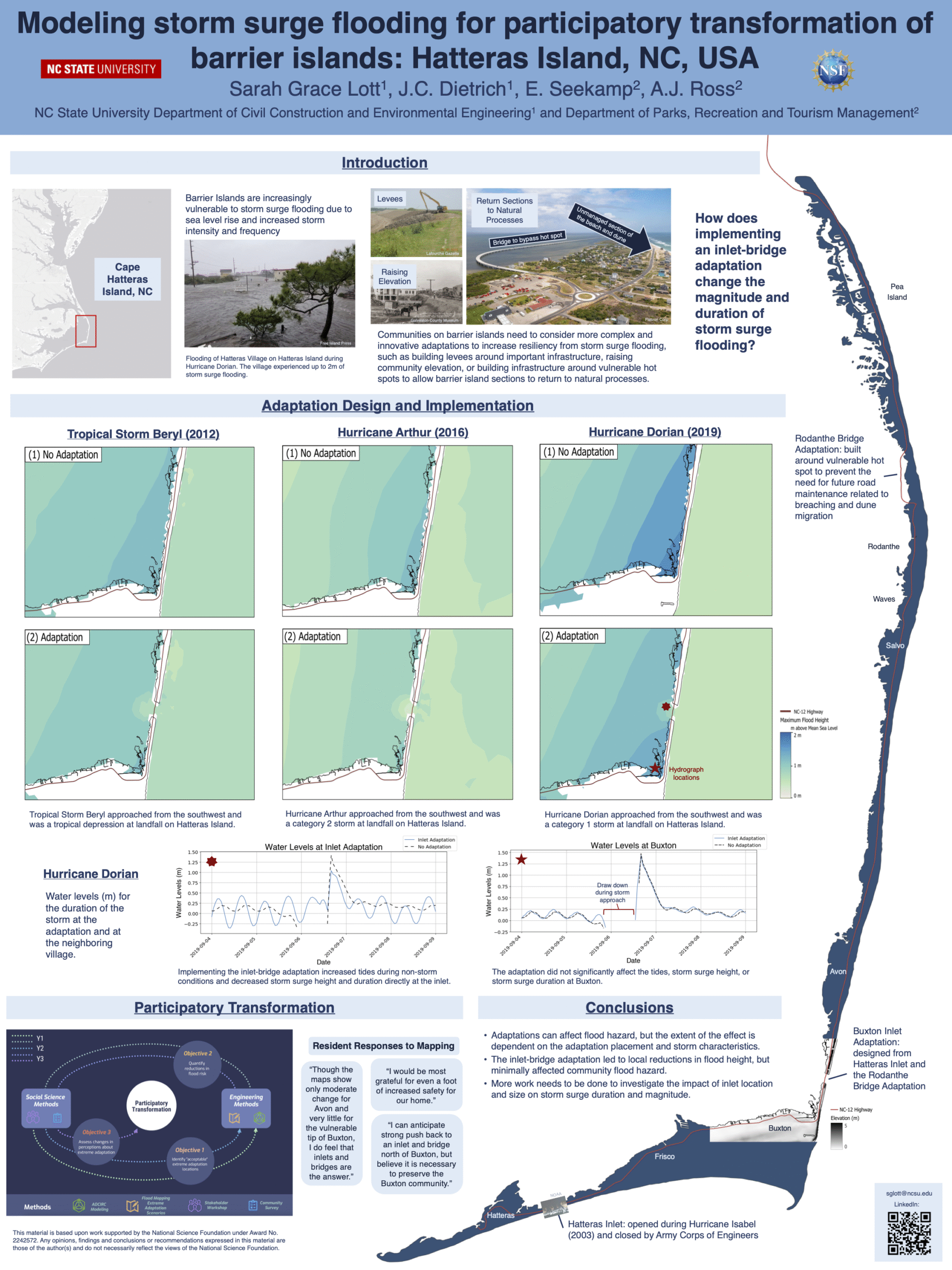
Modeling storm surge flooding for participatory transformation of barrier islands: Hatteras Island, NC, USA.
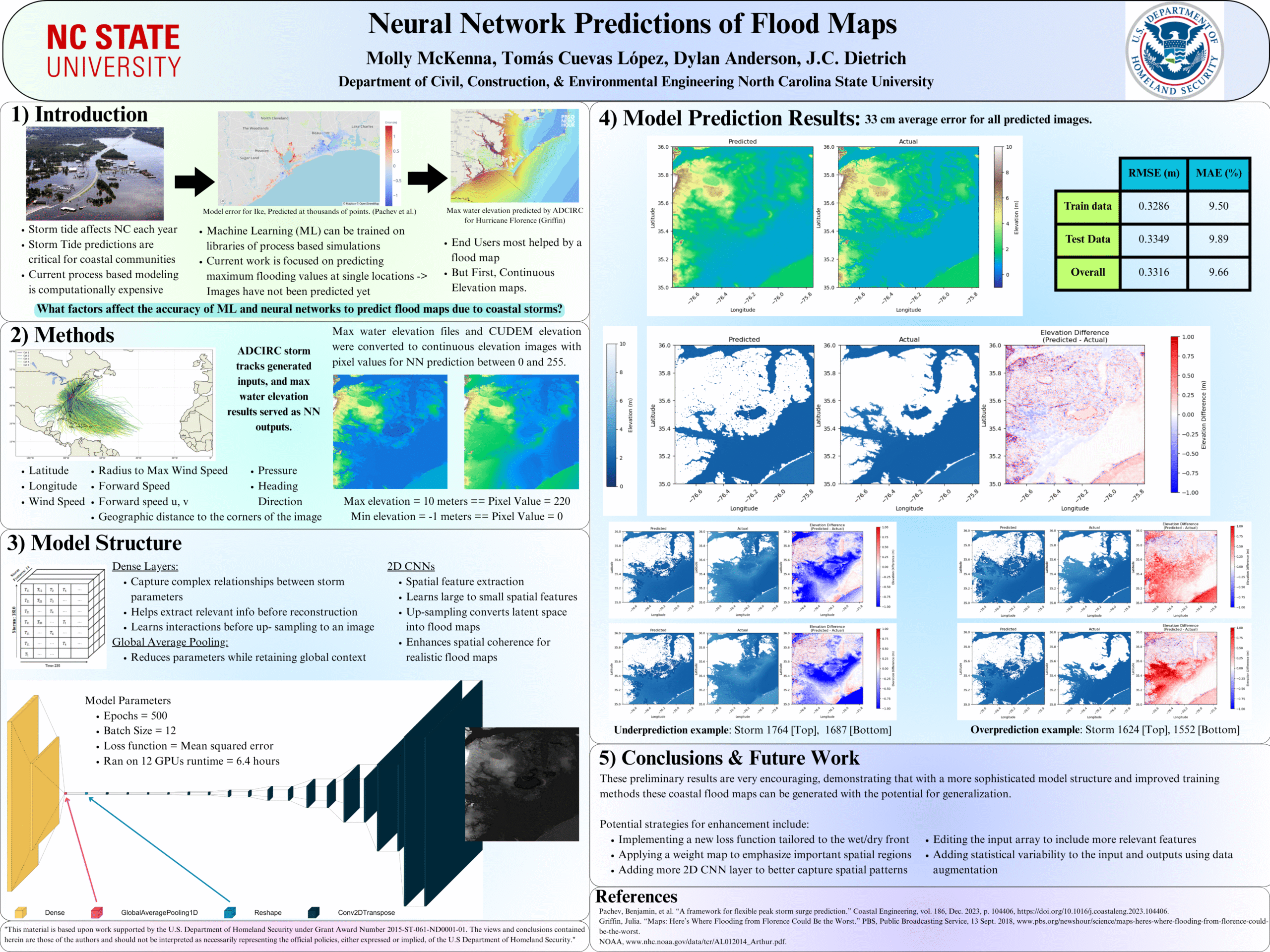
Neural Network Predictions of Flood Maps
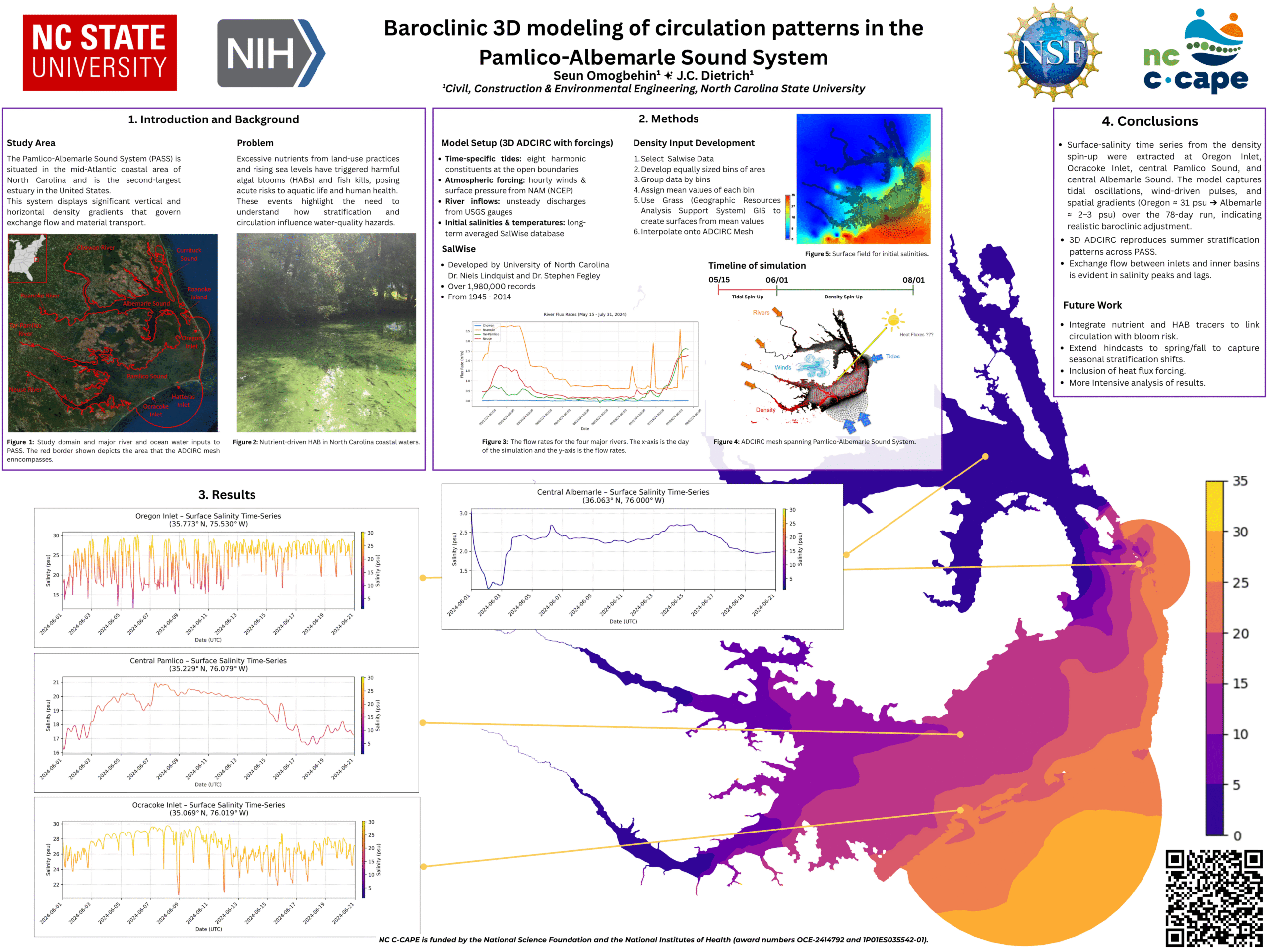
Baroclinic 3D modeling of circulation patterns in the Pamlico-Albemarle Sound System
Enhancing Coastal Resilience through Participatory Transformation of Barrier Islands
Barrier-island communities face flooding due to rising sea levels and stronger storms, and typical adaptations (protect, accommodate, retreat) may not keep up with increasing risks. Communities are now considering extreme adaptations, such as allowing an island section to ‘return to nature’ by removing roadways and other infrastructure. But these extreme adaptations transform the natural processes of and the community’s relationship with barriers. The effects on flood risks at nearby communities are not well understood, and it is not clear whether communities will ‘welcome the water’ or reject it as opposing their sense of place. This Disaster Resilience Research Grant (DRRG) project explores participatory transformation of barriers. Stakeholders will provide insights on place meanings across the barrier island and how floods affect these places and their connections to the community. The project also quantifies how flooding at a natural island section may change the hazard at neighboring communities, and whether these locations can be selected to minimize the risks while maximizing community attachments. These activities provide a framework for participatory transformation, as well as advance technologies for flood risk modeling that can be expanded to improve disaster resilience for communities along the U.S. Gulf and Atlantic coasts. This research also supports an immersive experience for students to collaborate across engineering and social-science disciplines to tackle the challenges of climate change.
JC Dietrich, EL Seekamp. “Enhancing Coastal Resilience through Participatory Transformation of Barrier Islands.” National Science Foundation, Directorate for Engineering, Division of Civil, Mechanical and Manufacturing Innovation, Disaster Resilience Research Grants, 2024/01/01 to 2026/12/31, $398,891 (Dietrich: $199,117).