Category Archives: Models
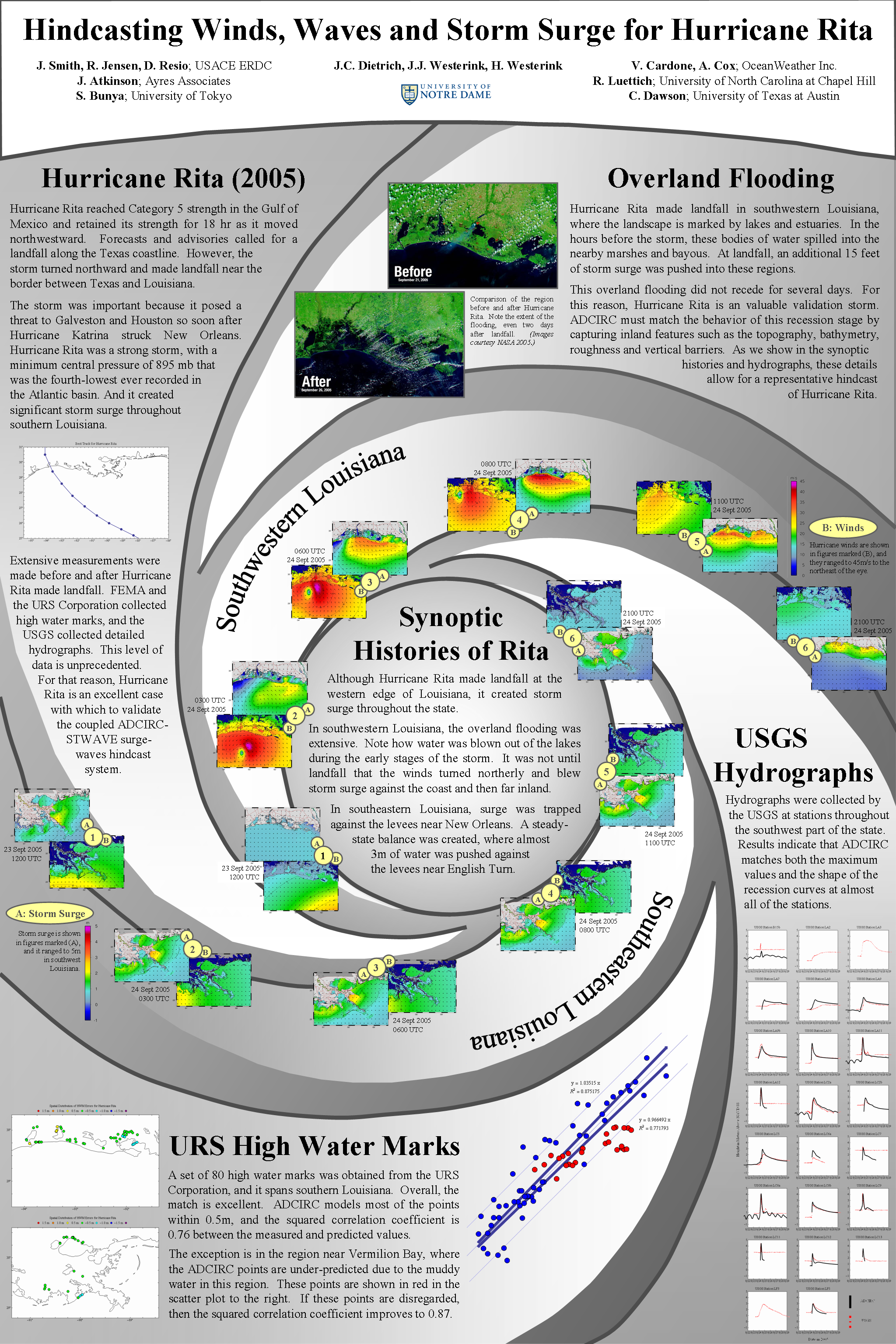
Hindcasting Winds, Waves and Storm Surge for Hurricane Rita
We presented our Hurricane Rita work at several meetings and conferences in 2007, so we developed a detailed presentation of our results. I decided that it would be a good idea to convert that presentation into a poster, so that we could have some bling in the hallway outside our lab.
Conference: ECM 2007
Conference: ADCIRC 2007
Refinements in Continuous Galerkin Wetting and Drying Algorithms
 Coastal ocean hydrodynamic models are used to simulate water surface elevations and circulation in oceans, lakes, estuaries, rivers and floodplains. One such model is ADCIRC (ADvanced CIRCulation), which was originally developed more than 15 years ago and which is used for a variety of purposes, including naval fleet operations, storm surge predictions, and larvae transport. ADCIRC assumed fixed land boundaries until a wetting and drying algorithm was implemented in 1995. However, this algorithm had two components that limited the performance of the model. First, nodes were required to remain “wet” or “dry” for a user-specified number of time steps before changing states. This component became restrictive in relatively flat regions, such as a flood plain, where it caused oscillations and slowed the propagation of flood waves. Second, in regions with steep bathymetry, mass balance problems and instabilities would occur when a thin film of water was allowed to flow uninterrupted. Changes based on a more physically-accurate description of the wetting and drying process were made recently to address these two problems. This paper describes the wetting and drying algorithm and those changes, and it applies the improved algorithm to an idealized domain that was designed specifically to test the two problem areas. The improved algorithm provides better stability and mass balance properties.
How Far Have We Come?
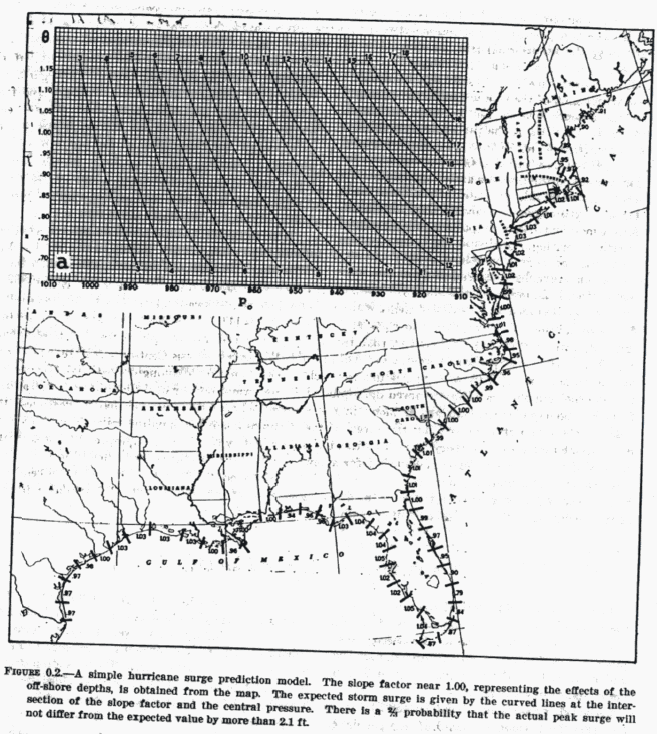
I came across this figure in a Weather Bureau report from 1963. (D.L. Harris, “Characteristics of the Hurricane Storm Surge,” Technical Paper No. 48, U.S. Weather Bureau, Washington, DC, 1963, pg. 10.) You can predict the hurricane storm surge using nothing but this figure! All you do is find the shape factor on the map, match it and the minimum pressure from your hurricane on the graph, and then read off the storm surge.
It makes me wonder why we’re wasting our time with math and equations and computers and what-not.